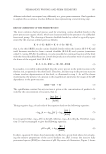
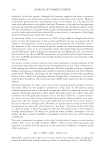
JOURNAL OF COSMETIC SCIENCE 130 perm solution, which is left on the hair for a suitable duration. The hair can then be rinsed and towel blotted before application of the neutralizing solution. The process fi n- ishes with one last rinse and drying of the hair. All manipulation can be performed with the hair anchored on the pegboards. The waving effi ciency can be expressed as percentage by comparing the length of the treated hair (Ltreated) with the initial tress length (Lo) and that of the “perfect wave” as dictated by the dimension of the pegboard (Lf), t ha t is, d d ¯ q100 ¢ ± treated Percentagewavingefficiency 1 L L L L (23) Sim ilarly, the longevity of the treatment can be assessed as a function of time (or other external stimuli) by equation (24), th at is, d d ¯ q100, ¢ ± treated 0 Percentagewavingefficiency 1 L L L L (24) wher e Lt is the tress length after the appropriate stimuli. SUMM ARY It i s possible to fi nd reviews and summaries pertaining to the topic of perm chemistry, which perhaps presents the impression that this area is well-understood. Accordingly, this overview attempts to take a somewhat different stance, by dedicating a signifi cant portion to what we still do not know about the process (perhaps in the hope that others will take up the cause). It is suggested that the underlying chemistry is relatively straightforward and can be found in any elementary textbook. But, before reactions can occur, it is necessary for reactants to come together, and to this end, it is surprising that so little is known about penetration routes and rates of diffusion into hair. It has been hypothesized that variability in diffusion rates could be a cause of differing activity between a common perm solution and hair obtained from a diverse population. Results shown herein indicate signifi cant differences in both rates and kinetic mechanisms as a function of hair type, and it appears reasonable to suppose that “perm- resistant hair” is a consequence of relatively slow bond cleavage that produces an insuffi cient degree of transformation during treatment time. However, an explanation for these differences in diffusion rates (and indeed a means of measuring this property) requires further work. Addressing this point seems crucial in producing any enduring makeover (perm chemistry or not) because transformation will likely require penetration of “actives” into the hair. Afte r all this time, it is rather remarkable that perm chemistry still likely represents the best available means for permanently changing the shape of hair. The hullaballoo created by the so-called Brazilian keratin treatments in recent years has reignited research interest in this area, but there is no immediate indication of a safe, effective substitute for perm chem- istry. Although not wanting to stifl e new ideas, it is obviously prudent to ensure that every- thing has been squeezed out of existing technologies before moving on to new areas, and it is again noted that perm products have changed very little since their inception in the 1940s. Research efforts since this time have primarily focused on alternative actives (although still predominantly thiols), yet incumbent thioglycolate-based products still overwhelmingly dominate the shelves. It is worth re-examining why this material has been so diffi cult to

PERMANENT WAVING AND PERM CHEMISTRY 131 displace. Thioglycolate is a small reducing agent with a relatively high oxidation potential that seemingly diffuses into hair reasonably well. As with all thiols, the activity can be fi ne- tuned through a combination of the solution concentration and pH. In addition, the extent of reaction can seemingly be curbed by the buildup (or presence) of exogenous DTG which limits the chance of overprocessing. On the negative side, a certain amount of structural damage is produced within the hair, although the extent is still considerably less than other shape-shifting alternatives (i.e., caustic relaxers and formaldehyde cross-linking). The two- step nature of the perm process and the odor are considered inconveniences, although the outcome of the process can be somewhat unreliable. The aforementioned summary creates a checklist when considering the resumes of new candidate molecules, but there is still the need for better understanding the role of hair itself. Wortmann and Kure (41) ascribe signifi cance to the cuticle structure and sug- gest it acts as a barrier to penetration, while also providing resistance to fi ber bending. The existence of different cortical cell types is recognized in the wool literature, where markedly different responses in alkali swelling have been reported (42). To date, only a few studies have extended these ideas into the hair literature (43–45). Fina lly, the potential for formulation-related innovations should not be overlooked, wherein there is the possibility for alternative ways of applying the actives to hair and for manipulating penetration through formulation variables, or possibly prewraps there is even the potential for packaging-related innovation to simplify the procedure. To this end, the appearance of the so-called smoothening creams on shelves, essentially represent- ing a conditioner–perm hybrid, is noteworthy. These products are likely to be less aggres- sive than true perms and are intended to produce their effect progressively with repeated treatments, rather than one single application. Hair fashions change over time, but there is a constant desire for those with straight hair to create curls, and those with curly hair to go straight. At the time of writing, straight hair styles have dominated for the past couple of decades, but the cycle that led to “big hair” styles in the 1970s and 80s seems destined to return at some time in the future. In the ab- sence of new technologies, perm chemistry will continue to be how these looks are achieved. ACKN OWLEDGMENTS In u ndertaking this review, it is impossible to not become nostalgic and recall working relationships and friendships that were encountered during employment at Helene Curtis in the early to mid-1990s. I learned so much from the likes of Craig Herb, Kate Martin, Bruce Solka, Bin Chen, Min Liu, Paul Neill, and many others. It was also a delight to work with such skilled and innovative engineers as Steve Dokoupil and Saul Llamas. But most of all, I remember Priscilla Walling who gave me my start in this industry and who contributed immensely to shaping me as an industrial scientist, by providing the perfect mix of encouragement, independence, and sage advice. I al so recognize the contributions of Tom Ventura, Pawel Milczarek and Daniel Kung to the SFTK data generation process. Similarly, Figures 10 and 11 were originally generated by Amy Qualls. I thank TRI-Princeton for access to their library of historical journals and acknowledge many hours of discussion with Randy Wickett on the topic of single- fi ber tensile kinetics. Finally, I thank Rushi Tasker for discussions pertaining to the current status of the perm industry.
Purchased for the exclusive use of nofirst nolast (unknown)
From: SCC Media Library & Resource Center (library.scconline.org)