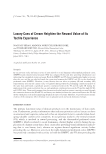
J. Cosmet. Sci., 72, 47–62 (January/February 2021) 47 Design and Evaluation of Topical Antioxidant Nanogel Formulations GÖKÇE TETIK, SEDA RENÇBER, EZGI T. ÖZOĞLU, EVREN A. YAPAR, SINEM Y. KARAVANA, and ÖZGEN ÖZER, Department o f Pharmaceutical Technology, Faculty of Pharmacy, Ege University, Izmir 35100, Turkey (G.K., S.Y.K , Ö.Ö.), Department of Pharmaceutical Technology, Faculty of Pharmacy, Izmir Katip Celebi University, Izmir 35620, Turkey (S.R.), Departm ent of Biochemistry, Faculty of Pharmacy, Izmir Katip Celebi University, Izmir 35620, Turkey (E.T.Ö), Departm ent of Analysis and Control Laboratories, Turkish Medicines and Medical Devices Agency, MoH Turkey, Ankara 06430, Turkey (E.A.Y) Accepted for publication September 29, 2020. Synopsis Transde rm al deliv ery of an active substance is promising, but a challenging option is available for local and systemic effects. The prolonged residence of formulation in the skin is important for topical delivery. In this study, it was aimed to develop a formulation that can overcome the stability and absorption problems of the vitamin C active substance by preparing nanogels. Nanogel-based materials have high drug loading capacity, biocompatibility, stability, and biodegradability, which are the key points to design a topical drug delivery system. Bovine serum albumin (BSA) and chitosan (CS) were used to prepare nanogels by a simple green self-assembly technique. Prepared nanogels were successfully used to entrap vitamin C, with an entrapment ratio between 86.08% ± 1.29% and 107.93% ± 1.04%. The studies started with vitamin C analysis and continued with characterization studies such as homogeneity, pH, viscosity, rheological properties, zeta potential, polydispersity index, particle size, and in vitro dissolution studies of nanogels. The antioxidant activities of the formulations were also tested by cell culture studies. The antioxidant activities of the nanogels were also tested by in vitro 2,2-diphenyl-1-picrylhydrazyl assay. Although topical vitamin C is effective in many ways, it has a risk of serious stability and absorption problems. The present work was aimed at developing pharmaceutically optimized topical nanogel formulations of vitamin C for antioxidant effect. An optimum nanogel formulation was composed of a 1:4 ratio of CS:BSA with (F19 formulation) in terms of entrapping vitamin C, formulation homogeneity, pH, viscosity, rheological properties, zeta potential, PI, particle size, in vitro dissolution and cell culture studies. The optimized formulation showed higher antioxidant effi cacy in vitro than vitamin C. In conclusion, prepared topical nanogel of vitamin C was stable and could be used with promising potential for topical application. INTRODUCTION Vitam in C, also known as ascorbic acid, has been widely used in pharmaceutical and cosmetic preparations for the formulation protection against oxidation and to exert Address all correspondence to Sinem Y. Karavana at sinemyaprak@hotmail.com.
Purchased for the exclusive use of nofirst nolast (unknown)
From: SCC Media Library & Resource Center (library.scconline.org)