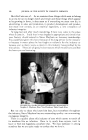
84 JOURNAL OF THE SOCIETY OF COSMETIC CHEMISTS The present criticism of unsophisticated attempts at measurements is by no means directed exclusively at cosmetics. It is easy to list numerous examples of inexpert applications from other classifications of consumer commodities. Within the field of cosmetics, however, Wenzel has pointed out that the so-called tests of chlorophyll effectiveness are perfect models of what experimental procedure should not be (1). On very much the same level are some of the attempts at measurement of quality uniformity and quality improvement of foods, textiles, and related materials (2, 3). By contrast, some reports by non-psychologists describing consumer product analyses show a refreshing awareness of the principles of psychophysics and psychometrics. Reading, study, and experience have taught these investigators to avoid the mere common sense approaches employed by others. For the purposes of this paper, we must answer the question: How is the psychologist by training and experience better prepared to as- sist the cosmetic manufacturer in product evaluation? The answer rests, at least partially, with his orientation. As a behavior specialist his policy is never to test a product itself, but to study the reac- tions of individuals to certain stimuli, which, in this case, happens to be in- dustrial products. He focuses, then, not on the hand cream, but on the consumer's reaction to the hand cream. In addition, the psychologist enjoys other advantages. He is equipped to apply methods of known value and reliability without the need for a series of trial-and-error developmental procedures he will arrange his experimental situation in the best interest of his respondents. Let us state the thesis in another way. When we are measuring human reactions, the emphasis must be placed on the respondent and not solely on the prod- uct. (The ideal control of the environment for psychometric and psycho- physical studies will be illustrated at a later time.) Finally, the psychol- ogist is specially equipped to interpret the responses he obtains and then to adjust his methods in relation to the results obtained. T•. INDtR•.CT APPROAC• In many instances, it is of interest to obtain considerable information about consumers' attitudes toward certain products. Advertising and other educational media have o•ken produced a general bias or set of prej- udices which may influence response to an object being tested alternately, they may suggest new ways of approaching the problems of totally new test hypotheses. In such cases, we have employed sentence completion or word association approaches of the type listed below. Complete the following sentences: Cake make-up is a skin covering for the Under-arm deodorants are The best use of rouge is

ANALYSIS OF PSYCHOLOGICAL PROPERTIES OF COSMETICS 85 What other word comes to your mind first when each of the following words is mentioned: Depilatory. Odor Bath oils Greasy Vanishing cream Permanent Mascara Color Rinse Indelible In actual test, these words are mixed with others not related by function, such as chair, hammer, etc. The answers obtained begin to assume a pattern which is surprising to the psychometrist and the cosmetic chemist alike. For example, "odor" alone may prove to be a pleasant association for most, while "depilatory" may be associated with an unpleasant odor. Bath oils may be for the affluent or for the ho• pollo• by association, while it may be learned that rouge is believed useful only for certain age groups, make-up for different skin conditions, and color rinses for graying hair. There the indirect ap- proach leads to very useful information where the direct is only misleading. Another type of sentence completion test which is often used is one de- signed at eliciting responses which reflect consumer attitudes toward a par- ticular product or class of products. For example, in the cosmetic field we have used the following questions which are representative of a wide range of problems: 1. I hate lipsticks that are always 2. A shampoo must ..... in order for it to be any good. 3. A really good bar of facial soap must cost at least 10e 25e $1.00 4. Deodorants don't work equally well for me because 5. In choosing a shaving soap, I am particularly concerned with its 6. I-don't like depila cbries because__ 7. The best soaps have in them. 8. Most of the less expensive perfumes are 9. I wish under-arm deodorants were 10. I know it is better to buy a premium nail polish because A T•.sT CAS•. To illustrate another difficulty encountered in attempts to get a true ex- pression from consumers, let us look at a very simple example. Consumers returned a large number of packages of a certain product, believed to be stable, to the stores with complaints about the odor. Some mild deterioration had apparently affected the contents, but the manu-
Purchased for the exclusive use of nofirst nolast (unknown)
From: SCC Media Library & Resource Center (library.scconline.org)