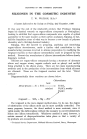
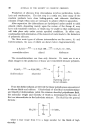
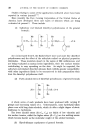
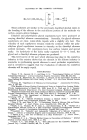
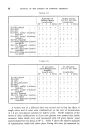
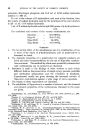
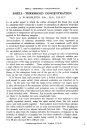
26 JOURNAL OF THE SOCIETY OF COSMETIC CHEMISTS Production of silicones from chlorosilanes involves purification, hydro- lysis and, condensation. The first step is a costly one, since many of the reaction products have close boiling-points, and elaborate distillation columns of high reflux ratio are necessary to achieve effective separation. After separation the chlorosilanes are hydrolysed under control to yield silanols which, depending mainly upon the nature of the Group R, may have only transient existence, or which may be stable so that condensation will take place only under certain specified conditions. In either case, condensation with elimination of the elements of water leads to the formation of polymeric silicones. The three main types of silicone intermediates are the mono-, di- and trichlorosilanes, the uses of which are shown below diagrammatically. H20 -- H20 2 R•SiC1 • 2 R oSi OH monochlorosilane silanol . RoSi--O--SiR• disiloxane The monochlorosilane can thus only dimerise. Its main use is as a chain stopper in the production of linear and cross-linked siloxane polymers. ß H•O R2S1C12 .... -+ R2Si(OH) 2' dichlorosilane silanediol 0 --•--0 --Si-- repeating unit of linear siloxane. From the dichlorosilanes are derived the linear polysiloxanes encountered in silicone fluids and rubbers. Cohydrolysis of trimethyl monochlorosilane and dimethyl dichlorosilane yields the common dimethyl polysiloxane fluid, the molecular weight and viscosity of which is determined by the ratio of the two intermediates in the hydrolysis mixture. The fluid has the general formula: Me•SiO-- i--O --O SiMe• • Me _In where n may range from 0 to a large number for the fluids of high viscosity.

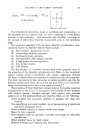
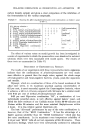
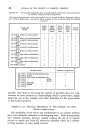
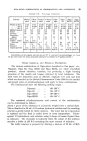
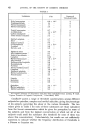
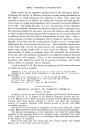
SILICONES IN THE COSMETIC INDUSTRY 27 R SiCI• mo • R Si(OH) 3 trichlorosilane --H,O -O--Si--O -- I o _ -- silicone resin unit The trifunctional chlorosilane leads, on hydrolysis and condensation, to the repeating unit of a silicone resin, the latter consisting of a cross-linked network of such molecules. Such molecules gain flexibility according to the amount of difunctional material incorporated prior to the hydrolysis stage. The properties associated with the linear dimethyl polysiloxanes, more commonly known as dimethyl silicone fluids, include: (a) Flat viscosity--temperature curves. (b) Outstanding oxidation resistance. (c) Inertness to many chemicals. (d) Incompatibility with organic materials. (e) A high degree of water-repellency. (f) Low surface tension. (g) Low toxicity. The introduction of a modified silicone fluid which possesses most of the properties of the dimethyl polysiloxanes but differs in one important respect, namely, greater compatibility with organic compounds, widened the scope of silicone fluid incorporation in pharmaceuticals and cosmetics. This fluid, too, has the further advantage of alcohol solubility and, like the dimethyl polysiloxane series, this material has been shown to be non-sensi- rising, non-irritating and to have a low order of toxicitf -6. The properties of those fluids have already induced the leading cosmetics manufacturers in the U.S.A. to incorporate silicone fluids in new products with marked success. Included amongst their present and potential applications in the pharmaceutical and cosmetics fields are the following: Water-repellent and non-smear additives in lipsticks and chap pre- ventives. Non-rancidifying and water-repellent oils in hair grooming preparations and home permanent waves. Water insoluble vehicles in suntan lotions and creams. Bases for burn unguents. Heat-resistant bases for speciality cosmetics and creams for television and film use. Water-repellent bases for hand creams. Medical, domestic and industrial skin protectants.
Purchased for the exclusive use of nofirst nolast (unknown)
From: SCC Media Library & Resource Center (library.scconline.org)