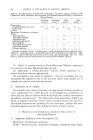
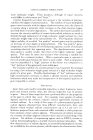
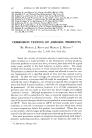
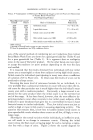
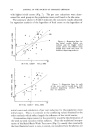
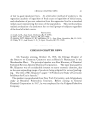
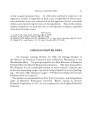
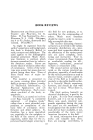
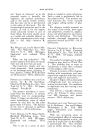
DEGERMING ACTIVITY OF TOII,ET BARS 413 and the minimum number of weeks, days and basins consistent with re- producible results. Since each subject acts as his own control a large portion of the subject- to-subject variation is limited by test design. A variety of techniques have been used for calculating per cent in re- duction in cutaneous bacteria. The simplest is the arithmetic mean of the individual per cent changes in count from that on plain toilet soap back- ground to that after use of the germicidal bar. Occasionally, however, a subject's final count is larger than his initial count, giving what is called a reversal, or negative per cent reduction. Examples of three ways of handling reversals in calculating mean per cent reduction are given in Table 2. The data shown are artificial, set up so that the means of the two columns are the same and each pair of data is shown twice, once in reverse order. It is obvious that three different conclusions may be drawn from the data de- pending on the rule used to determine the individual per cent change in count. For our own work, Rule 3 has been adopted as the most realistic since our example was designed for zero change and the range of changes is kept between -+- 100 per cent and - 100 per cent. During the past few years it has become apparent to us that initial counts (of several hundred individual counts) are not normally distributed, while the logarithms of both initial and final counts are distributed more uniformly. Accordingly, the initial and final counts for each subject were converted to logarithms, and the per cent reduction was calculated from the mean log difference. This method works reasonably well when all initial counts are grouped closely about the population mean initial count. It fails to give an accurate picture if many of the initial counts in a single test are low, since a highly significant correlation was found between logarithm of initial count and the logarithm of the per cent reduction using data from seven different panels totaling 102 subjects. This indicated that the ap- parent effectiveness of a germicidal bar is greater when tested on subjects with high initial counts as contrasted with those having low initial values. As a further check on the influence of the level of initial count on the per cent reduction, paired high and low initial counts were drawn from these TABLE 3---DEPENDENCE OF PEP. CENT REDUCTION ON LEVEl, OF INITIAL COUNT IN THE SEP.IAL BASIN WASH TEST Average Initial No. of % 95% Count Subjects Reduction Limits Low* 25 36 2-59 Hight 25 72 53-84 Each reduction significant and also significantly different from each other (P 0.05). * Range of low counts 140,000-740,00{,. No. of reversals 7. • Range of high counts 760,000-4,000,000. No. of reversals 2.

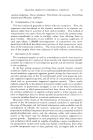
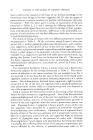
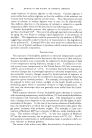
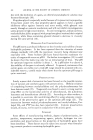
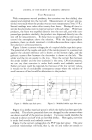
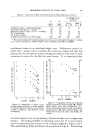
414 JOURNAl, OF THE SOC1ETY OF COSMETIC CHEMISTS same seven panels, the dividing line arbitrarily set at 750,000. For each initial count below 750,000 taken from a given panel, one above 750,000 was chosen at random from the same panel. A total of 25 values was ob- tained for each group. Since each antiseptic bar involved was represented equally in each group, the average per cent reduction should be the same for each group, provided the initial counts are not a determining factor. A difference was quite evident in the average per cent reductions for the two groups (Table 3). The low initial count group gave an average reduction of 36 per cent (95 per cent confidence limits, 2-59) which was significant (P0.05). The high initial count group gave a highly significant reduc- tion (P0.01) of 72 per cent (95 per cent confidence limits, 53-84). To compound the confusion even more, the difference in per cent reductions between the two groups was also significant. In this analysis, at least, the interpretation can be made that the antiseptic soaps as a group tested on the seven panels were twice as effective on subjects having initial counts over 750,000 as on those with counts below 750,000. The ideal solution would be to use only those individuals having initial counts at or near the population mean. This is impractical when panels are composed of laboratory personnel in limited numbers. Alternate proposals have been: (a) selecting subjects whose initial counts are within one standard deviation of the panel mean, (b) selecting only individuals whose initial counts are greater than a certain minimum, e.g., one million, and (c) assuming the population mean of initial counts as the initial count for each subject in a given test (3) (1.54 million in our case). One objection to the first two alternatives is the sometimes serious limi- tation on the number of satisfactory subjects available. The last two fre- quently lead to overestimates of the efficiency of a test product. Compari- TABLE 4---CoMPARISOIg OF DIFFERENT METHODS OF CALCULATION OF PER CENT REDUCTIOIg IN SERIAL BASIN WASH TEST Good Degerming Product Hand Bacterial Counts* Per Cent Initlair Finalt Basis of Calculation Reduction:l 5072 969 3857 34O 2835 766 2804 268 2768 229 2362 364 1922 8 1543 275 1115 370 629 56 522 16 385 83 Arithmetic mean 83 (53-109) Logarithmic mean 89 (76-95) Initial count assumed 1540 89 (69-96) Only initial counts over 1000 Only initial counts within one Std. Dev. 89 (67-96) 90 (59-97) * 000 omitted. t Average of fourth basin counts on two successive days. :1 Values in parentheses are 95% confidence limits.
Purchased for the exclusive use of nofirst nolast (unknown)
From: SCC Media Library & Resource Center (library.scconline.org)