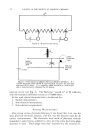
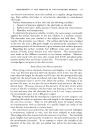
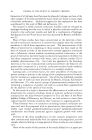
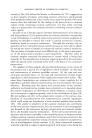
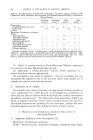
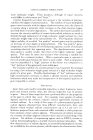
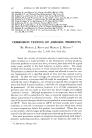
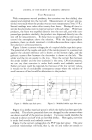
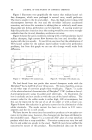
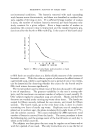
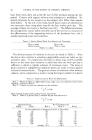
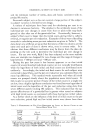
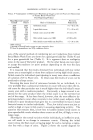
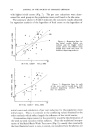
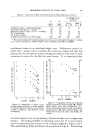
DEGERMING ACTIVITY OF TOILET BARS 419 TABLE 6--ANALYSES OF PEa CENT REDUCTION IN HAND BACTERIAL COUNTS Low-High Count Analysis* A B Low I High I SB72 SB82 (A + B) (A + B) Arithmetic means of individual changes 12 47 15 56 Geometric mean (Log I - Log F) 19 53 Regression analysis calc'd. at I -- 1.5 millions 62 63 No. of individuals 12 22 15 19 No. below 1 million 6 9 15 0 Average initial count (I) in Thousands 1326 1756 421 2530 * Per cent reductions determined on basis of control counts arbitrarily divided into 1 million or less (low I) and above 1 million (high I) from combined panels SB72 and SB82. equilibrium) value for an individual might vary. Preliminary results in- dicate that a steady state is reached after numerous washes and that this plateau may be constant fbr a given background despite wide week to week variations in counts for the first few serial basins. z z --i- _ o o o o n u a e e m ß ß A 2 3 4 5 10 BASIN NUMBER Figure 8.--Logarithm of basin count plotted against reciprocal of basin number to obtain estimate of plateau value (basin number -- infinity) scale shifted to avoid overlapping. 10- o o 2 3 BAS IN It is conjectured that ß ß ß ß ß e eO ß o ß o o o øøo• o 4 5 I0 I$ co NUMBER Figure 9.--Logarithm of basin count plotted against reciprocal of basin number. O--Fifteen serial basins, plain soap background O-- fifteen serial basins after one week on excellent deodorant bar 1--three selected basins one month later using only plain soap during the month. the same situation, but a lower plateau, will prevail after use of a degerming product. The impracticability of obtaining counts for 15 or more basins can be circumvented by recourse to the technique applied in Figs. 8 and 9. Data publisEed by Pohle and Stuart (4) are plotted in Fig. 8. Eliminating

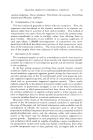
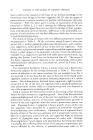
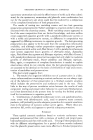
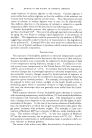
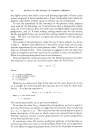
420 JOURNAL OF THE SOCIETY OF COSMETIC CHEMISTS the highly erratic first basin count and plotting logarithm of basin count versus reciprocal of basin number give a linear relationship from which the plateau value (basin number equal to infinity) can be extrapolated. To test the hypothesis of the constancy of the plateau value, subjects were used for the following: (a) 15 serial basins after a background of plain soap, (b) 15 serial basins after one week's use of a highly effective germicidal preparation, and (c) 8 serial washes, taking counts only for the second, fourth and eighth basins one month later, during which time plain soap was used. We have not had time to repeat the second phase with the ger.mi- cidal product. The results of this preliminary study for one of these subjects are shown in Fig. 9. Despite wide differences in the earlier counts both control series indicate approximately the same plateau value. Pohle and Stuart (4) also show an example of this. This technique is suggested with the hope that other investigators now have data that can confirm or reject the hypothesis. Work is continuing along these lines in our laboratory. This extrapolation method assumes that the following equation describes the reduction in counts for successive basins after the third basin: logy,,-- logy•, = - where y. = count on nth basin y= = final equilibrium count n basin number b = a constant However, we observed in Fig. 8 that data for the early basins do not lie on a straight line indicating that the equation does not hold for these early basins. An alternate equation is log (y,• - y•o) = log (yo -- yoo) • cn where y0 = the initial count c = a constant The remaining symbols are as previously defined. If we take the value for y= obtained by extrapolation and set y0 equal to the count first basin, we obtain a straight line for all basins when we plot log (Y,,-yoo) vs. log (yo-yoo). This indicates that the second equation gives a better description of the rate at which counts are reduced basin-to-basin. The first equation remains a useful approximation for quick extrapolation to the final equilibrium count. In conclusion, then, the various traditional methods of interpreting cu- taneous bacterial count data in the Serial Basin Wash Test are in agreement for very effective dege•ming preparations, but fail in the proper assessment
Purchased for the exclusive use of nofirst nolast (unknown)
From: SCC Media Library & Resource Center (library.scconline.org)