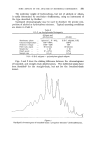
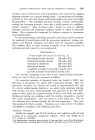
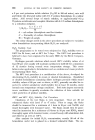
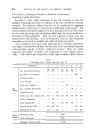
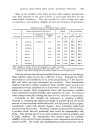
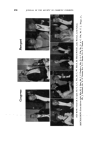
SOME ASPECTS OF THE ANALYSIS OF HOUSEHOLD DETERGENTS 351 The molecular weight of hydrocarbons, but not of alcohols or ethers, is easily determined by semi-micro ebulliometry, using an instrument of the type described by Heitler •. Gas-liquid chromatography may be used to elucidate the precise com- position of alcohol or hydrocarbon mixtures. Typical operating conditions are shown in Table 8. Table :• G.L.C. on desulphonated detergents ,'llkanes and alkylbenzenes A lcoh ols Stationary phase .. Apiezon L, 5--10•o P.F..G. adipate, 10% Column temperature .. 130--160øC 150øC Detector voltage .. 1750--1250 750 Flow rate, argon .. 40 ml/min 40 ml/min Sensitivity .... X 10 X 10 Chart speed .... 9"--12"/h 12"/h Sample size .... 0.1 [•1 0.1 [•1 N.B.-•P.E.G. adipate = polyethylene glycol adipate. Figs. I and 2 show the striking difference between the chromatograms of branched- and straight-chain alkylbenzenes. The individual peaks have been identified • for the straight-chain, but not for the branched-chain isomer. Figure 1 Gas-liquid chromatogram of branched-chain ("propylene tetramer") dodecylbenzene.

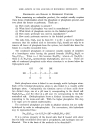
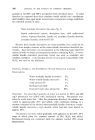
352 JOURNAL OF THE SOCIETY OF COSMETIC CHEMISTS Figure • Gas-liquid ½hrornatograrn ooe straight-chain dodecylbenzene. Infrared spectrophotometry can assist in identifying hydrocarbons, yield- ing such information as presence of aromatic rings, ratio of CHa - to - CH2 - groups, degree of branching, and classification of the a-carbon atom of the side chain as secondary, tertiary or quaternary. The kinds of examination outlined above usually lead to a successful identification, but there is in addition at least one comprehensive scheme of systematic qualitative analysis of detergents *'•. VOLUMETRIC DETERMINATION OF ACTIVE I•GREI)•E•r Provided its molecular weight is known, almost any artionic detergent can be determined by titration with a long-chain quaternary ammonium salt in a two-phase system, the phases usually, but not necessarily, being water and chloroform. In 1948 two methods were published utilising this principle but using fundamentally different processes for the determination of the end-point. 1. The Epton Method* The indicator is methylene blue, the structure of which is shown below. (CH•)2N S N (CH•) 2 CC This is a cationic dyestuff, i.e. the coloured ion is positively charged. A suitable titrant is cetyltrimethylammonium bromide, C•6H a aN (CLI,) aBr.
Purchased for the exclusive use of nofirst nolast (unknown)
From: SCC Media Library & Resource Center (library.scconline.org)