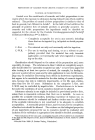
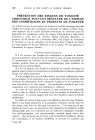
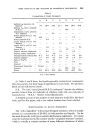
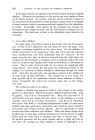
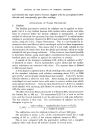
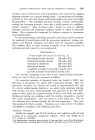
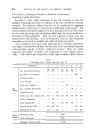
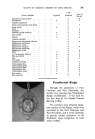
SOME ASPECTS OF THE ANALYSIS OF HOUSEHOLD DETERGENTS Table 2 Compositions of Liquid Detergents 349 Sodium C•2 benezene sul- phonate ...... Sodium C•2 ether sulphate (3 E.O.) ...... Ammonium nonyl phenol/ E.O. sulphate .... Nonyl phenol/10 E.O. con- densate ...... Nonyl phenol/4 E.O. .. Lauric M.E.A./4 E.O. con- densate ...... Lauric M.E.A./3 E.O. con- densate ...... Lauric M.E.A ..... Sodium toluene sulphonate Sodium xylene sulphonate Unsulphonated hydrocarbon Sodium sulphate .... P•O 5 as NaaPO4 .. Urea .... G1¾cerol .... Fluorescent brightener Ethanol .... Water .... A B C D E F G 5.7 18-6 24-4 21.1 16.0 26.4 18.3 .... 15.0 -- -- -- -- 3.9 .... 15.0 .... 7.2 -- -- 4.2 ..... -- -- -- 8.7 -- -- -- -- 1'8 .... 5.4 .... 3.0 -- -- -- 6.8 -- 3.1 -- 4.8 -- -- -- 4.8 .... N.T. 0.5 N.T. 1.5 1.0 0.8 0.8 1.7 0.8 0.4 0.9 1.3 1.2 0.8 1.5 -- 0.3 .... -- 3.8 5.0 -- -- 4.0 -- ...... 0.2 Present ...... .... 16.5 8.6 -- 75.0 63.4 62.0 65.0 47.0 46.9 75.5 N.T.----Not Tested. As Tables I and 2 show, the liquids generally contain fewer components than the powders, but their range of ingredients is much wider. The products listed are all well-known brands. N.B. The term "nonyl phenol/10 E.O. condensate" denotes the addition product formed from ten molecules of ethylene oxide with one molecule of nonyl phenol. "M.E.A." denotes monoethanolamide. A detailed account of the analysis of such mixtures would fill a fair-sized book, and for this paper, only a few salient features have been selected. IDENTIFICATION OF ACTIVE INGREDIENT The "active ingredient" is the actual detergent substance, which is usually present at a concentration of 20-30}/0 in both powders and liquids. By far the most frequently used type is sodium a!kylbenzene sulphonate. For many years the material used in this country was the "propylene tetramer" product, which is actually a complex mixture of many different substances of which

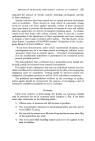
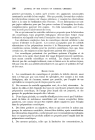
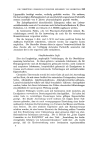
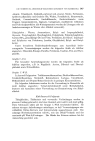
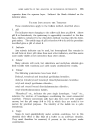
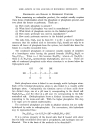
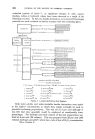
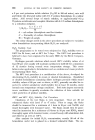
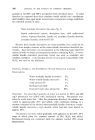
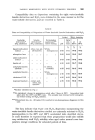
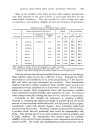
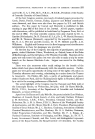
350 JOURNAL OF THE SOCIETY OF COSMETIC CHEMISTS the two shown below are typical. Both structure and size of the side-chain vary over a wide range. CH] CH 3 CH 3 CH] • SO•Na CH• CH• CH• SO3Na The propylene tetramer type of detergent is objectionable because it is .......... .•,.• by ........ , methods of sewage treatment, and for this reason it is being gradually replaced by the "biologically soft" straight chain isomer. This too is a complex mixture. The structure shown below is a typical molecule, but the phenyl group may be attached anywhere in the paraffin chain except the 1-position. The length of the chain also varies and some branching is usually present. CH•- CHz- CHi' CH2-• CHz- C H2- CHz- CHz- C Hz- C H2- CH • SO,No Sodium lauryl ether sulphate, C•2H25 (OCeH4)aOSOaNa, first appeared in a household detergent only a few years ago. Secondary alkyl sulphates of the Teepol type were at one time extensively used in washing-up liquids, but are not now used in any major product. The range of detergent type found in practice is thus quite narrow, and identification is not usually difficult, even when a mixture of detergents is present as in some of the liquids. Non-ionics and alkanolamide-type foam promoters are easily separated by passage through a mixed-bed ion exchange resin, and are usually readily identified by comparison of their infra-red spectra with standard spectra. Alkyl sulphates and alkyl ether sulphates are differentiated from sulphonates by the fact that they are hydrolysed by prolonged boiling with N hydrochloric acid. Alky! and alkylaryl sul- phonates resist hydrolysis but are converted to the parent hydrocarbon by boiling with phosphoric acid of boiling point 215øC. This is conveniently done in a Dean and Stark apparatus of the "heavy entrainer" type. The oil collected in the side-arm will contain fatty acids if an alkanolamide was present, and it is therefore washed with dilute alkali before examination.
Purchased for the exclusive use of nofirst nolast (unknown)
From: SCC Media Library & Resource Center (library.scconline.org)