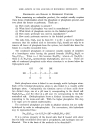
SOME ASPECTS OF THE ANALYSIS OF HOUSEHOLD DETERGENTS 357 PHOSPHATES AND BORATE IN DETERGENT POWDERS When examining an unfamiliar product, the analyst usually requires three items of information about the phosphate or phosphates present, and two about the borate or perborate. These are: (a) How much phosphate is present ? (b) What kind of phosphate was used in manufacture ? (c) What kinds of phosphate survive in the finished product ? (d) How much perborate was used in manufacture ? (e) How much perborate survives in the finished product ? The ratio P•O5: B•Oa may be from 10: 1 to 20: I mid it is therefore necessary that the method used to determine P205 should not only be to remove all traces of phosphate from the system, but should also leave the borate in a readily measurable form. The condensed phosphates of commerce consists mainly of members of a homologous series having the general formula (NaPOa)n. Na•O, or Nan+2PnO3n+ •. When n=l this becomes NaaPO• when n----2, Na•P•O7 when n=3, Na•P30•0 (pentasodium triphosphate), and so on. These are salts of condensed phosphoric acids whose structure is as shown below for triphosphoric acid. OH OH OH HO --PmO --P--O--P--OH O O O Each phosphorus atom is linked to one strongly acidic hydrogen atom. Each of the terminal phosphorus atoms is also linked to a weakly acidic hydrogen atom. Consequently the titration curves of these acids show two distinct steps, one at a pit near 4, corresponding to the diacid salt NanH•PnO3n+•, and the other at a pH near 10, corresponding to the fully neutralised salt. (Orthophosphate shows a distinct intermediate step, co- responding to the mono-acid salt. With the higher phosphates this step is so vague as to be almost undetectable.) The condensed phosphates are stable in alkaline solution but are easily hydrolysed by acids to orthophosphate. For convenience, this hydrolysis may be represented thus: Nan+•PnOa•+•q- (n-l) H•Oq-2H*--•nNaH•PO•q-2Na +. It is a curious property of the diacid salts that if treated with silver ions the fully neutralised silver salt is precipitated, and hydrogen ions are liberated. This is the basis of the methods to be described 8'9.

358 JOURNAL OF THE SOCIETY OF COSMETIC CHEMISTS DETERMINATION OF PHOSPHATE AND BORATE For the determination of phosphate it is necessary to remove or destroy all surface active matter, which would otherwise vitiate the experiment. A sample of the detergent, containing 0.7--1'0 g P205 and about 0.05 g B203 is ashed. The phosphate is hydrolysed by boiling with dilute nitric acid. The pH is then adjusted to 4.5 by careful neutrahsation with N sodium hydroxide, so that the phosphate is present as H2PO4-ions. 100 ml of 10•o silver nitrate solution is added. An equilibrium is set up: H2PO4--k3Ag+•Ag3P04 • q-2H + This is a true equilibrium, appreciable concentrations of all four com- ponents being present. If the liberated acid is titrated with N sodium hydroxide the equilibrium shifts continuously to the right, and at pH 6'0 neutralisation and precipitation are complete. Because the acid being titrated is a strong one (nitric acid), the pH at the end point is virtually independent of the concentration. Each ml of N alkali is equivalent to 0'0355 g P•Os. The borate, which is equivalent to the perborate used in manufacture, is then readily determined. The silver phosphate is filtered off. Excess sodium chloride is added and the precipitated silver chloride is also filtered off. The pH of the tiltrate is adjusted to 5.5 with 0.1 N alkali, glycerol equal to about half the volume of the solution is added, and the boric acid titrated to pH 8'5 with 0.1 N alkali. Each ml of alkali is equivalent to 0.01539 g of NaBOa.4H•O. The surviving perborate in the finished product is determined on a fresh sample, either by titration with permanganate or by treatment with acidified potassium iodide solution and titration of the liberated iodine with thiosulphate. DETERMINATION OF MEAN CHAIN LENGTH OF CONDENSED PHOSPHATES The examination described in the preceding section conveys to the analyst how much phosphate was present in the sample. It does not indicate what kinds of phosphate are present, nor what kind was used in manufacture. Indeed, because the manufacturing process causes some degradation, the kind put in can only be inferred from the kinds still present. There are several ion-exchange or paper chromatographic procedures which will give a precise analysis, both qualitative and quantitative, of the survi- ving phosphates. But it is usually adequate, and much quicker, to determine the mean chain length, i.e. the average number of phosphorus atoms per molecule. The principle of the method is this. If a sample of the condensed
Purchased for the exclusive use of nofirst nolast (unknown)
From: SCC Media Library & Resource Center (library.scconline.org)