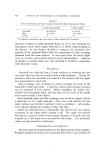
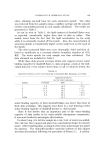
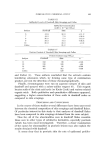
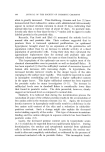
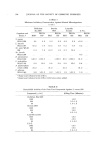
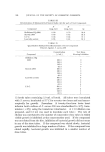
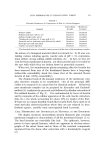
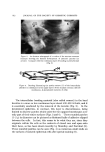
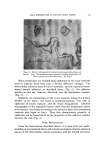
SKIN SUBSTANTIVITV 501 heavy metals or for oxidizing agents, letheen (0.07% azolectin and 0.5% Tween 80*) for quaternary ammonium compounds, and 1% Tween 80 for bis-phenols. Skin substantivity studies were carried out using calf skin discs pre- pared from calf-skin (dehaired, untanned, and pickled) obtained from Barrett & Co., Newark, N.J. The method of preparation was a modifi- cation of that of Vinson et al. (2). The calf skin was immersed in a salt solution containing 31.2 g. of sodium chloride and 2.5 g. of sodium bicar- bonate per 1000 ml. of distilled water. The ratio of calf skin to salt solution was 1:4 (w/v). When the calf skin reached a pH of 5.6, as ascertained by measuring pH of liquid squeezed from the skin, it was rinsed thoroughly in water to remove excess salt. It was then de- hydrated by passing through two daily changes of 95% ethanol. The dehydrated skin was pinned to a board and allowed to air dry (five to six hours). Discs were cut from the dried skin using a 15 mm. diam- eter cork borer and discs weighing 70 mg. (q-20 mg.) were sterilized by ethylene oxide prior to use in tissue substantivity determinations. RESULTS Determination of Minimum Inhibitory Concentration. The inhibitory concentrations of the four test compounds for each of the test organisms is presented in Table I. Repeated tests using the same strains on rare occasions showed slight but insignificant variations in these reported concentrations. Each of the compounds was more effective against the gram-positive organisms than it was against the gram-negative organisms and all of the compounds were equally effective against the yeast, C. albicans. The addition of protein, in the form of horse serum, reduced the antimicrobial activity of each of the compounds. While all of the compounds displayed excellent antimicrobial properties, none of the four evaluated compounds possessed significantly greater activity against all of the test organisms (see Table I). Bactericidal Activity. The results of the evaluations of each of the compounds for bactericidal activity against S. aureus-209 are presented in Table II. Each of the compounds is bactericidal at the lowest level tested. The differences in killing times vary slightly from compound to compound but these differences are not significant. Furthermore, in routine use, the minimum concentration in a topical preparation would not be less than 1000 T/ml. and for this reason no one of the com- * Atlas Chemical Industries, Inc., Wilmington, Del.

502 JOURNAL OF THE SOCIETY OF COSMETIC CHEMISTS TABLE I Minimum Inhibitory Concentration Against Selected Micro6rganisms (v/ml.) Hollichem Sterwin Laurodin Hq 3300 #904 Acetate C.P.C. Organism and BHI & BHI & BHI & BHI & Strain # BHI • HS b BHI HS BHI HS BHI HS S. aureus WLRI 296 0.4 0.9 L. buccalis WLRI 297 0.2 1.9 Str. mitis WLRI 298 0.4 7.8 Str. faecalis WLRI 299 ...... K. pneumoniae WLRI 300 50.0 100.0 L. acidophilus WLRI 301 3.9 15.6 F. polymorphum ATCC 10953 31.2 ... C. albicans WLRI 045 1.9 31.2 0.2 0 2 0 2 . . ß . 09 31 2 02 0.9 0.9 3.9 0.2 1.9 0.2 7.8 0.2 1.9 0.2 15.6 ... ......... 0.2 100.0 50.0 100.0 31.2 3.9 3.9 15.6 3.9 ... 31.2 ... 31.2 31.2 1.9 31.2 1.9 Brain heart infusion broth (Difco). Brain heart infusion broth (Difco) with horse serum added. TABLE II Bactericidal Activity of the Four Test Compounds Against S. aureus-209 Compound (3,/ml.) Killing Time (Minutes) Hollichen HQ 3300 1000 0.5 2OO 0.5-1.0 50 1.0-1.5 Stcrwin #904 1000 0.5 250 0.5 50 O. 5-1.0 Laurodin acetate 1000 0.5 250 0.5 50 4,0-5.0 c.P.C. 1000 0.5 250 0.5 50 1.0-1.5
Purchased for the exclusive use of nofirst nolast (unknown)
From: SCC Media Library & Resource Center (library.scconline.org)