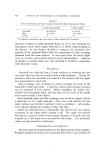
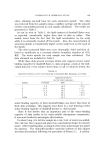
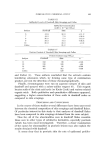
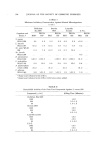
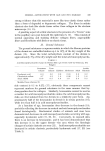
COMPARATIVE CHEMICAL STUDY 493 ether, allowing one-half hour for each extraction period. The ether was removed from the samples using a capillary syringe and the amount of ether extractables present in each sample calculated. The results are presented in Table I. As can be seen in Table I, the lipid content of dandruff flakes was, as expected, considerably higher than that of skin or callus. This mainly arises from the fact that the lipid accumulates on the scalp while it is constantly washed off the hands. Also, the concentration of sebaceous glands is considerably higher on the scalp than on the back of the hands. The ether extracted flakes were next thoroughly dried and then al- lowed to equilibrate in a constant relative humidity chamber at 81% RH. The water uptake for each sample was then calculated. The data obtained are included in Table I. While these data present averages which only suggest a lower water binding capacity for dandruff flakes vs. skin scrapings, a look at the indi- vidual data for every subject shows that, in all 15 subjects tested, the TABLE II Ninhydrin-Positives as Per Cent Isoleucine in Dandruff, Skin Scrapings, and Callus Ninhydrin-Positives (As Per Cent Isoleucine) Subject Dandruff Skin 1 5.8 18.3 --12.5 2 13.3 19.0 -- 5.7 3 11.2 19.6 -- 8.4 4 6.7 22.0 --15.3 5 6.5 23.5 --17.0 Callus ... 10.4 ... water-binding capacity of their dandruff flakes was lower than that of their skin scrapings this suggests that there is a real lowering of the water-binding capacity of dandruff keratin v•. skin keratin. Since it was known that an important part of the water-binding capacity of skin resides in its water-soluble nitrogenous components, it was next derided to investigate this fraction. To about 5 mg. of a fat-free sample in a vial, 3 ml. of water was added. The vial was then capped and placed on a mechanical shaker for twenty hours. After centrifugation, an aliquot of the clear supernatant was taken for analysis. The ninhydrin-positive material content of this aliquot was then determined, following the procedure of Rosen (1). A calibra-

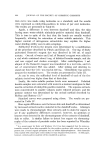
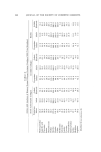
494 JOURNAL OF THE SOCIETY OF COSMETIC CHEMISTS tion curve was made using isoleucine as a standard, and the results were expressed as ninhydrin-positives in terms of per cent isoleucine. The results are presented in Table II. Again, a difference is seen between dandruff and skin, the skin having more water-soluble ninhydrin-positive material than dandruff. This is true in spite of the fact that the hands are usually washed frequently, allowing for extraction of water soluble materials. This higher content of nitrogenous extractables may explain the higher water-binding ability seen in skin scrapings. Sulfhydryl levels in the keratin were determined by a modification of the procedure described by Flesch and Khun (2). One mg. of finely pulverized Bennett's reagent dye was dissolved in 100 mi. of amyl acetate. One mi. of water and 2 ml. of Bennett's reagent were added to a vial which contained about 5 mg. of defatted keratin sample, and the vial was capped and shaken overnight. After centrifugation, 1 ml. aliquot of the Bennett's reagent was transferred to a test tube, and 0.5 mi. of concentrated HC1 was added. After mixing and allowing to stand one hour the O.D. was read at 540 mu. Glutathione was used to prepare the standard curve. The results are presented in Table III. As can be seen, the sulfhydryl level of dandruff of each of the five subjects tested was higher than that oi their skin. Lastly, the water-soluble penrose levels were measured. Defatted keratin samples were extracted with water in a manner analogous to that used in extraction of ninhydrin-positive material. The aqueous extracts were concentrated to smaller volumes under reduced pressure, and the penrose content was determined by the orcinol method described by McRay and Slattery (3).* Standard curves were prepared using ribose. The results are pre- sented in Table IV. Here again differences exist between skin and dandruff as determined by increased orcinol-reactive material in the dandruff scales. Attempts were made to chromatograph these extracts and to stain for sugars to see if any qualitative differences occurred however, no penroses or hexoses were detected in the chromatograms of the extracts of dandruff, skin or callus. A similar failure to detect free sugars via chromatog- raphy of the extracts of psoriatic scales has been reported by Wheatley * In a recent paper by Berry and Warkany (5), it has been suggested that the water ex- tractable material from skin responsible for the positive reactions with orcinol may not be pentose but a bound organic phosphate such as uridine diphosphoglucose. Such materials when reacted with orcinol give colors similar to that obtained with pentoses. In this paper, however, orcinol positive material will be considered as penrose.
Purchased for the exclusive use of nofirst nolast (unknown)
From: SCC Media Library & Resource Center (library.scconline.org)