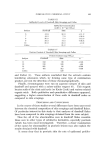
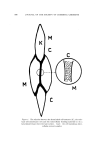
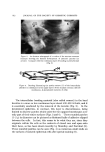
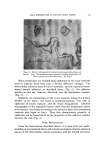
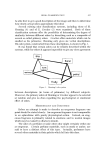
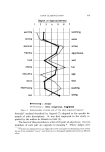
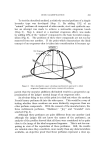
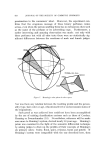
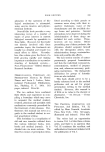
CELL MEMBRANES IN KERATINIZED TISSUE 5O9 enclosing the protein and (c) that of the intercellular cement, and these components are partly in parallel and partly in series (Fig. 1) (1). As with a chain this structure is no stronger than its weakest link. The keratinized tissues are classified as desquamating (or soft) keratins (the epidermis) and the nondesquamating, hard and persistent keratins (nails, hair, etc.). This classification emphasizes an important functional distinction: the constantly growing epidermis maintains its near-constant thickness by disintegration into cellular fragments on its outer face, whereas the persistent nails and hairs are more permanent structures, which must be cut or worn away by use. In considering the coherence of these tissues we have clearly to take into account not only the properties of the protein (keratin) enclosed within the cells but also the properties of the cell membranes and the materials bordering them. Most of what we know concerning these matters comes from the study of hair (or wool), and this work will be summarized first. An account of similar investigations concerning skin will then be described. In each matehal we are concerned in the first place to establish the fine histology of the tissue and, second, to determine the chemical nature of each of the morphologically distinct components. CELL •/[EMBRANES AND INTERCELLUAR MATERIAl, IN HAIR That hairs were cellular tissues was appreciated by the earlier histologists, but the fact was often overlooked in the days when it was fashionable to regard a hair as a rod of a more or less uniform polymer, "keratin." A detailed description of the keratinized cells based on electron micrographs was given by the present writer and his colleague, Birbeck (2). The special chemical nature and the important role of the cell membranes was clearly recognized in this work, and since that time numerous other investigators have confirmed and extended these findings (3). Briefly, the oriented bundles of intracellular keratinized filaments are enveloped by a modified cell membrane, which usually appears thicker than the original plasma membrane of the prekeratinized cells in the hair follicle but is clearly derived from it. These membranes are cemented together by rather uniformly thick sheets of some distinctly different substance, the whole forming what might be termed the "cell membrane complex." The cell membrane complex is effectively a con- tinuous phase, a reticulum extending throughout the cortex of the hair and enclosing the keratinized filaments in its interstices (Figs. 1 and 2). When the hair is stretched, the membrane complex and the intracellular

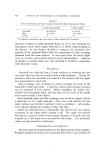
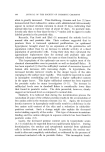
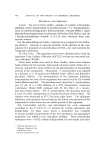
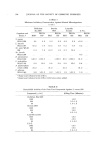
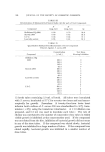
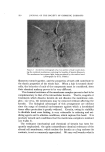
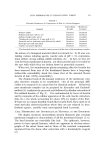
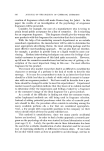
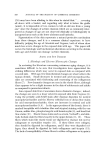
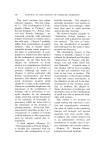
510 JOURNAL OF THE SOCIETY OF COSMETIC CHEMISTS •" :i :::::':-.:.•... i •'" ,":: ...'i:. • •'.•.• ? ß . ß ........' ß •...X.i.•.: :...:5.. ' .. .-...:....:.. ' "•:'i{! ..•' . • ?•.. ...:.... ,.•: .:.... :.... :• w. .•. -." [•".'. :. ':-' :•, -. ".' . . .. "' '" .'½ :.'C•:, ,:... . . .....•,,:•.. •...•.., Figure 2. An electron micrograph of a cross section of hair (wool) show- ing the resistant membranes enclosing the bundles of ktratin filaments. The membranes here appear light, being unstained by the method used. (photograph by B. K. Filshie) filaments extend together, and the properties of both will contribute to the elastic properties of the whole hair. When a hair is treated chemi- cally, the behavior of each of the components must be considered, since their chemical makeup proves to be very different. The chemical resistance of the membrane complex proves in fact to be complementary to that of the intracellular keratin. That is, reagents or treatments which dissolve keratin do not dissolve the membrane com- plex vice versa, the membranes may be removed without affecting the keratin. The biological advantages of this arrangement are obvious since the range of chemical environments against which a keratinized tissue offers protection is greatly widened. Keratin, owing its stability to disulfide bond cross linking, is very vulnerable to reducing and oxi- dizing agents and to alkaline conditions, which rupture this bond. It is precisely toward such conditions that the membrane-complex is resistant (see Table I). The resistance (mechanical and chemical) of keratin has been fre- quently emphasized the quite extraordinary chemical resistance of the altered cell membranes, which enclose the keratin as a bag encloses its contents, is not so commonly appredated. We may well wonder what is
Purchased for the exclusive use of nofirst nolast (unknown)
From: SCC Media Library & Resource Center (library.scconline.org)