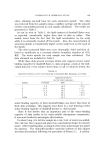
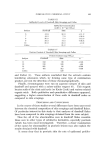
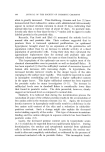
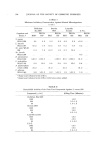
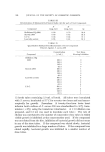
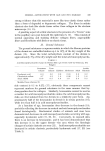
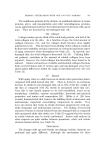
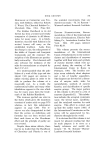
SKIN SUBSTANTIVITY 503 pounds could be considered to be significantly better than any of the others (see Table II). Qualitative Measure of Substantivity. Broth dilutions of the com- pounds were prepared in duplicate. (A modified Rammelkamp (3) broth dilution was used in which the minimum inhibitory concentration M.I.C. was determined to within 0.1 -•/ml.). To each tube in one series of dilutions a sterile skin disc was added. Both sets of dilutions were incubated in a water bath at 37øC for four hours. The discs were then removed from the tubes and discarded. Each of the tubes received the same inoculum of S. aureus and all tubes were incubated at 37øC for forty-eight hours. (Inoculum: A twenty-four hour brain heart in- fusion broth culture of S. aureus-209 was standardized to 500/0 trans- mission (+2%) using the Lumetron Colorimeter. A 10 -a dilution in broth was made, and 0.1 ml. of this dilution was used to inoculate each tube.) After incubation the tubes were read macroscopically for growth and the lowest concentration of test compour•d inhibiting growth was reported as the end point (M.I.C.). If the test compound was substantive to the skin tissue, the dilution series, which contained the skin discs, had its end point (M.I.C.) shifted to a higher concentration of the test compound. The greater this shift relative to the M.I.C., determined in tubes without addition of skin discs, the greater was the substantivity of the compound. The binding of the compound to the discs accounted for this difference in end point. This can be expressed mathematically as a substantivity potency ratio (Sp) for a given compound by the following formula: D--M -- X 100 = Sp M D = inhibitory concentration in series that had skin discs M = inhibitory concentration in series without skin discs Sp = substantivity-potency ratio Comparison of the Sp for several compounds can be used for the selection of a compound based on skin substantivity (see Table III). Quantitative Titration of Skin Substantivity. Each sterile skin disc was rehydrated, placed in 10.0 ml. of a known concentration (0.1%) of the test compound mixed for one minute at 37øC and finally pressed with a 50 g. weight between two Microfiber Glass Prefilter pads* (one minute) to remove excess fluid. The disc was serially washed in each of * Millipore Filter Corp., Bedford, Mass.

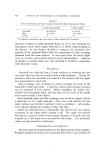
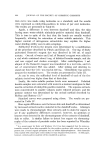
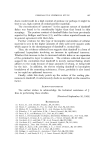
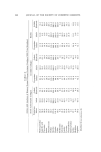
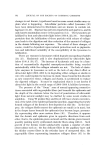
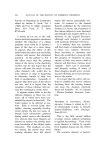
5O4 JOURNAL OF THE SOCIETY OF COSMETIC CHEMISTS TABLE III Determination of Substantivity-Potency Ratio (Sp) for each of Test Cronpounds D M Compound (meg./ml. ) ( meg./ml. ) Sp Hollichem HQ 3300 0.90 0.70 28.6 Sterwin/½904 0.60 0.45 33.3 C.P.C. 0.55 0.35 57.1 Laurodin acetate 0.65 0.40 62.5 TABLE IV Quantitative $ubstantivity Measurement of Test Compounds Titrated Against S. aureus-209 Concentration Test Rinse Compound (v/ml.) Showing Inhibition Hollichem 3300 Sterwin #904 Laurodin acetate C.P.C. 500.0 0 250.0 0 125.0 0 62.5 0 500.0 4 250.0 0 125.0 0 62.5 0 500.0 8 250.0 2 125.0 0 62.5 0 500.0 7 250.0 2 125.0 1 62.5 I 15 broth tubes containing 5.0 mi. of broth. All tubes were inoculated with S. aureus, incubated at 37øC for seventy-two hours and read macro- scopically for growth. (Inoculum: A twenty-four-hour brain heart infusion broth culture of S. aureus-209 was standardized to 50% trans- mission (4-2%) using the Lumetron Colorimeter. A 1:10 dilution was prepared, and 0.2 mi. was used to inoculate each tube.) The rate of elution was correlated to the number of consecutive rinse tubes in which visible growth is inhibited at the concentration used. If the compound was not eluted from the disc, inhibition of bacterial growth did not occur in any of the rinse tubes. If the compound was eluted slowly, bacterial growth was inhibited in a large number of tubes. If the compound was eluted rapidly, bacterial growth was inhibited in a smaller number of rinse tubes.
Purchased for the exclusive use of nofirst nolast (unknown)
From: SCC Media Library & Resource Center (library.scconline.org)