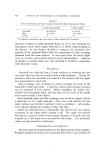
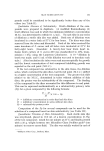
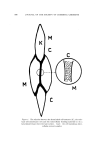
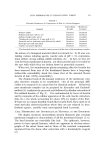
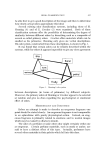
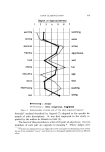
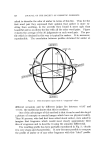
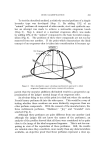
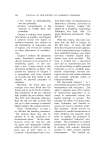
ODOR CLASSIFICATION 517 be able first to get a good description of the image and then to determine how closely actual odors approximate this ideal. Several existing odor classification systems, including those of H. Henning (4) and of E. Crocker (5) were examined. Both of these classification systems offer the possibility of determining the degree of similarity between different odors by describing each as a composite of several so-called primary odors. Crocker offers matedhals which can be smelled as his primaries Henning only gives six verbal descriptions. His odor prism, constructed from these descriptions, is shown in Fig. 1. It was found that certain odors can be reliably described within the systems, while for others it appears impossible to get any close agreement • spicy J flora[ putrid I frui•y Figure 1. Henning's odor prism between descriptions (in terms of primaries) by different subjects. Moreover, the primary odors of Henning or Crocker appear to be selected at random and give no clues regarding the psychological or emotional effect of odors. METHODOLOGY AND DISCUSSION Before an attempt is made to describe an erogenous fragrance one point should be stated clearly: An erogenous fragrance is not comparable to an aphrodisiac with purely physiological action. Instead, an erog- enous fragrance is primarily related to emotions and to mental images which may be evoked by olfactory stimuli. The odor of a perfume or some other odor might certainly strike one as erogenous. Certain perfume materials, such as musk or amber, are said to have a distinct effect of this type. Actually, perfumers have several other materials in their palette which fall into this class.

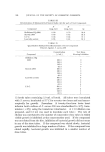
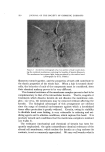
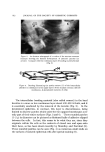
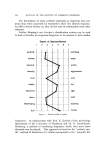
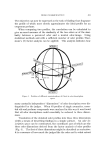
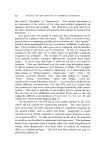
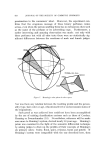
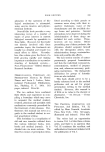
518 JOURNAL OF THE SOCIETY OF COSMETIC CHEMISTS The description of some perfume materials as erogenous does not mean that these materials by themselves elicit the desired response. As will be shown further on, they do this only in combination with other odorants. Neither Henning's nor Crocker's classification system can be used to find or describe an erogenous fragrance or to compare it with similar Degree of Appropriateness 1 2 3 4 5 6 7 exciting - -- -- soothing strong -- • • weak passive - • •'- active friendly ___ i aggressive loud -- -'/ soft empty •,. full beaut if ul ...... I ugly stern •_ / mild ß d ep ressi ng exa It ing dull I___ • •, biting Figure 2. Partial profile of amber fragrances. In collaboration with Prof. K. Eyferth of the psychology department of the University of Hamburg and Dr. R. Randebrock, Hamburg, a method of classifying fragrances which does meet these demands was developed. This approach is based on the "polarity pro- file" method of Hofstatter (6) (which corresponds to the "semantic dif-
Purchased for the exclusive use of nofirst nolast (unknown)
From: SCC Media Library & Resource Center (library.scconline.org)