.1. Soc. Cosmetic Chemists, 16, 507-514(1965) The Contribution of the Resistant Cell Membranes to the Properties of Keratinized Tissues E. H. MERCER, D.Sc., Ph.D.* Presented before the Third Congress of the I.F.S.C.C., June 21-26, 1964, New York City Synopsis--Electron microscopy of hard (hair) and soft (epidermis) keratin suggests that modified cell membranes are cemented by a continuous layer in the former and by a patchy layer in the latter. These differences are related directly to the desquamating nature of epidermis and the persistent behavior of hair and nails. This intercellular "membrane complex" is more resistant to chemical attack than intracellular keratin but easily dissolved by tryptic or peptic digestion. INTRODUCTION The keratinized tissues are cellular tissues, i.e., they consist almost entirely of cells filled with keratin and with a very sm all amount of intercellular binding material. They are to be contrasted with the con- nective tissues where the intercellular material enormously preponder- ates and the properties of the tissue are effectively those of the inter- cellular fibers and colloidal matrix. To take one property as an ex- ample, the physical strength of a cellular tissue is the strength of the complex of the component cells and their adhesive connections. Thus in a keratinized tissue the physical strength depends on: (a) the strength of the intracellular keratinized protein, (b) that of the cell membranes * John Curtin School of Medical Research, Australian National University, Canberra, Australia. 507

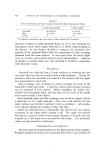
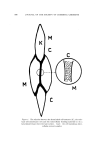
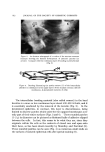
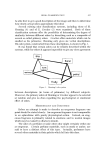
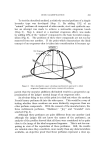
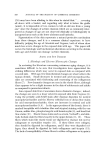
508 JOURNAL OF THE SOCIETY OF COSMETIC CHEMISTS Figure 1. The relation between the keratinized cell contents (K), the resis- tant cell membranes (M) and the intercellular bonding material (C) in a keratinized tissue (here the hair cortex). Inset: the cell membrane-inter- cellular cement complex
Purchased for the exclusive use of nofirst nolast (unknown)
From: SCC Media Library & Resource Center (library.scconline.org)