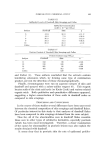
DERMAL ALTERATIONS WITH AGE AND SUN DAMAGE ,533 "Grenz" zone the great depth of elastotic fibers in actinic elastosis below the level of penetration of ultraviolet light the gradual increase of depth with time of agents used for tattoos and the gradual decrease in hyaluronic acid with increased chondroitin sulfate B in the deeper layers of pig skin (42). The latter is a situation analogous to the association of infant skin with more hyaluronic acid than chondroitin sulfate B and skin from the elderly with the reverse pattern (23). This also suggests that actinic elastosis may be partially reversible by avoidance of further sun damage since new connective tissue is forming continually at the epidermal-dermal junction and growing downward. Regression of the changes of actinic elastoses in transplanted actinically damaged skin has been reported (43). It is difficult to explain why a substance such as topically applied testosterone, which is thought to act by increasing the acid mucopolysac- charide content in the dermis, produces changes which are interpreted as reversal of sun damage effects in the presence of already increased dermal acid mucopolysaccharides (44). This may be due to the degree of poly- merization and molecular weight of newly synthesized polysaccharide. At the present, the only practical approach to the cosmetic problem of actinic elastosis appears to be avoidance of excessive exposure to the sun and use of artificial sunscreens. The synthesis of new connective tissue following injury of the skin by surgical planing or caustics such as trichloroacetic acid or phenol is a more drastic approach whose value is still not adequately defined (45). SUMMARY Histological and biochemical alterations in aging and sun-damaged human dermis (actinic elastosis) are quite different. Aging changes are characterized by decreases in non fibrous protein, acid and neutral mucopolysaccharides, and slight increases in the fibrous proteins, col- lagen, and elastin. Sun-damaged skin (actinic elastosis) has marked increases in acid and neutral mucopolysacchride and elastin with de- creased amounts of collagen. The prevention of changes due to chronic sun damage in susceptible individuals by the avoidance of excessive exposure to sunlight and use of artificial sunscreens is recommended. (Received December 7, 1964) REFERENCES (1) Unna, P. G., The Histopathology of the Diseases of the Skin, Trans. by Walker, N., Mac- millan & Co., New York, 1896.

534 JOURNAL OF THE SOCIETY OF COSMETIC CHEMISTS (2) Kissmeyer, A., and With, C., Brit. J. Dermatol., 34, 175 (1922). ($) Lund, H. Z., and Sommerville, R. L., Am. J. Clin. Pathol., 27, 183 (1957). (4) Smith, J. G., Jr., and Lansing, A. I., J. Gerontol., 14,496 (1959). (5) Knox, J. M., Cockerell, E.G., and Freeman, R. G., J. Am. Med. Assoc., 179,630 (1962). (6) Franklin, B., in Untermeyer, L., A Treasury of Ribaldry, Popular Library, New York 1959. (7) Cooper, Z. K., in Lansing, A. I., Cowdry's Problems of Aging, Williams and Wilkins Co., Baltimore, 1952. (8) Gillman, T., Penn, J., Bronks, D., and Roux, M., Arch. Pathol., 59, 733 (1955). (9) Sams, W. M., Jr., and Smith, J. G., Jr., J. Invest. Dermatol., $7, 447 (1961). (10) Hale, D. M., Cromartic, W. J., and Dobson, R. L., Ibid., $$, 293 (1960). (11) Loewi, G., Glynn, L. E., and Dorling, J., J. Pathol. Bact., 80, i (1960). (12) Smith, J. G., Jr., Sams, W. M., Jr., Davidson, E. A., and Clark, R. D., Proc. Intern. Congr. Dermatol., XII, Washington, D.C., 1962 Intern. Congr. Series No. 55, 1963. (13) Mandl, I., Advan. Enzymol., 23, 163 (1961). (14) Lansing, A. I., Ciba Found. Colloq. Aging, 1, 88 (1954). (15) Banffrid, W. G., and Brindlcy, D.C., ]. Invest. Dermatol., 41, 9 (1963). (16) Smith, J. G., Jr., Davidson, E. A., Sams, W. M., Jr., and Clark, R. D., Ibid., $9, 347 (1962). (17) Loewi, G., Biochim. Biophys. Acta, 52,435 (1961). (18) Boas, N. F., Arch. Biochem. Biophys., 57, 367 (1955). (19) Clausen, B., Lab. Invest., 11,229 (1962). (20) Loewi, G., and Meyer, K., Biochim. Biophys. Acta, 27, 453 (1958). (21) Prodi, G., J. Gerontol., 19, 128 (1964). (22) Smith, J. G., Jr., Davidson, E. A., Tindall, J.P., and Sams, W. M., Jr., Proc. Soc. F. xptl. Biol. Med., 108,533 (1961). (23) Smith, J. G., Jr., Davidson, E. A., and Taylor, R. W., in Montagna, W., Advances in Biology of Skin: VI--Aging (in press). (24) Verzar, F., Int. Rev. Connective Tissue Res., 2,243 (1964). (25) Bjorksten, J., J. Am. Geriat. Soc., 10, 125 (1962). (26) Sams, W. M., Jr., and Smith, J. G., Jr., in Montagna, W., Advances in Biology of Skin: VI--Aging (in press). (27) Smith, J. G., Jr., Davidson, E. A., and Clark, R. D., Nature, 195,716 (1962). (28) Smith, J. G., Jr., Arch. Dermatol., 88, 382 (1963). (29) Miller, E. J., Martin, G. R., Piez, K. A., Biochem. Biophys. Res. Comm., 17,248 (1964). (30) deDuve, C., in deReuck, A. V. S., and Cameron, M.P., Ciba Foundation Symposium Lysosomes, Little, Brown, & Co., Boston, 1963. (31) Woods, J. F., and Nichols, G., Federation Proc., 23, 550 (1964). (32) O'Dell, D., cited by Jackson, S. F., in Braeher, J., and Mirsky, A. E., The Cell, Bio- chemistry, Physiology, Morphology, Vol. VI, Academic Press, New York, 1964. (33) Weissmann, G., Federation Proc., 23, 1038 (1964). (34) Weissmann, G., and Fell, H. B., J. F. xptl. Med., 116, 365 (1962). (35) Davidson, E. A., personal communication (1964). (36) Hvidberg, E., Kvorning, S. A., Schmidt, A., and Schou, J., Acta Pharmacol. Toxicol., 15, 356 (1959). (37) Idem, Ibid., 15,365 (1959). (38) Burk, P. G., and Smith, J. G., Jr., unpublished observations (1964). (39) Hay, E. D., and Revel, J.P., Develop. Biol., 7, 152 (1963). (40) Porter, K. R., in Connective Tissue: Intercellular Macromolecules, a Symposium spon- sored by the New York Heart Association, Little, Brown, & Co., Boston, 1964.
Purchased for the exclusive use of nofirst nolast (unknown)
From: SCC Media Library & Resource Center (library.scconline.org)