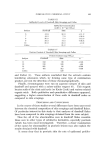
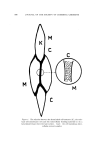
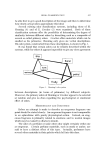
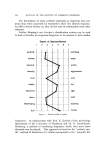
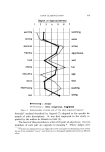
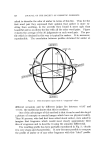
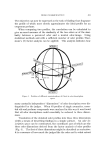
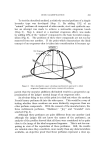
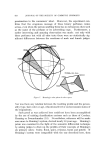
ODOR CLASSIFICATION 525 the points representing his primary odors should occupy positions in the odor space such that a prism would be formed by connecting them. The diagrams show that this is not the case. On the right, Henning's prism is shown in its theoretical form, on the left the way it appears from the odor profiles of the judges it does not form a prism. The majority of known odors cannot be described by use of Henning's six primary odors. Crocker was inspired by Henning's work to develop a revised model. He assumes the existence of only four basic odors: acid, fragrant, burnt and caprylic. Each odor is described by indicating, on an eight-point scale, to what extent each primary odor is a component of the odor being described. A serious weakness of this system, as Ross and Harriman (11) pointed out, lies in the fact that there is no proof that these four basic odors really represent those characteristics which make one odor different from another. Moreover, the use of only four characteristics leads to an unstable profile in practical use, it is not reproducible. It was found that stable profiles could be obtained only through the use of a large number of polarities--29 in the case described here. It must be concluded that the traditional classifications of odors fail to provide the means for a reliable description of odor impressions or of mental images of fragrances. This was one of the reasons why an at- tempt was made to develop a new method which would be useful as a guide to the development of appropriate and successful perfumes. SUMMARY In the field of fragrance it is feasible to obtain a description of a men- tal image of an ideal. It is feasible also to determine to what extent an existing fragrance approaches this ideal. In Western culture there exists a definite image of the ideal erogenous fragrance. Using the described method, which was developed in cooperation with Prof. K. Eyferth and Dr. R. Randebrock, it is possible to create fragrances which come close to this ideal. This odor-psychometric method is, in several ways, more practically useful than the classification system described in the literature. It permits an insight into the fine structure of the world of odor perception, a world which is complex and mysterious even for the expert. The data obtained by the use of the semantic differential method, in spite of the subjectivity of the individual judgments which make up the profiles, are reproducible and in a sense objective and reveal the existence

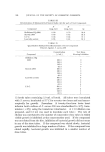
526 JOURNAL OF THE SOCIETY OF COSMETIC CHEMISTS of relations which seem to have general validity. These data make possible the sdection of the most appropriate fragrance, the one which most closely approximates the recognized ideal image. If the manu- facturer, market researchers and psychologically trained perfumers co- operate in the search for the most effective perfume for a given product, this new method can become a powerful tool in the search. The method is new and stands at the beginning of its develop- ment. Frequent practical application will certainly lead to further im- provements and refinements. But even at this early stage, its ad- vantages are apparent: chance or the taste of a few individuals--ob- stacles in the selection of a truly appropriate fragrance--are eliminated, and the decision is based squarely on the verdict of potential buyers and users of the product. (Received October 6, 1964) (10) (11) REFERENCES (1) United Press International, Delhi, January, 1964. (2) Paukner, E., Parfuem. Kosmetik., •19, 750 (1958). (3) Paukner, E., J. Soc. Cosmetic Chemists, 11, 517 (1960) of. Am. Perfumer, 79 (2), 37 (1964). (4) Henning, H., Der Geruch, Johann Ambrosius Barth, 2nd ed., Leipzig, 1924. (5) Crocker, E. C., Proc. Sci. Sect. Toilet Goods Assoc., 6, 24 (1949). (6) Hofstatter, P. R., and Lubbert, H., Psychol. und Praxis, 2, 71 (1958). (7) Osgood, C. E., Suci, G. J., and Tannenbaum, P. H., The Measurement of Meaning, Uni- versity of Illinois Press, Urbana, Ill., 1957. (8) Thurstone, L. L., Vectors of Mind, University of Chicago Pressr Chicago, 1935. (9) Jellinek, P., Die psychologischen Grundlagen der Parfumerie, Huthig Verlag, Heidelberg, 1951. Zwaardernaker, H., Die Psychologie des Geruches, Leipzig, 1895. Ross, S., and Harrirnan, A. E., Am. J. Psychol., 62,339 (1949).
Purchased for the exclusive use of nofirst nolast (unknown)
From: SCC Media Library & Resource Center (library.scconline.org)