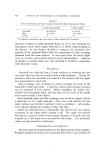
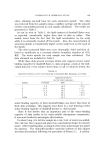
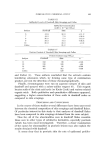
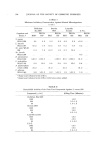
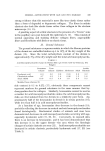
COMPARATIVE CHEMICAL STUDY 495 TABLE III Sulfhydryl Levels of Dandruff, Skin Scrapings and Callus Sulfhydryl Concentration (mM X 10 -3 per 100 g.) Subject Dandruff Skin A 6 41.8 30.6 +11.2 7 44.5 7.9 +36.6 8 20.0 7.0 +13.0 9 53.3 14.5 +38.8 10 20.9 20.0 +0.9 Callus ... 21.2 . .. TABLE IV Pentose Content of Dandruff, Skin Scrapings and Callus Pentose Content (mg./100 g.) Subject Dandruff Skin A 11 242 96 +146 13 210 126 +84 14 261 92 +169 15 451 312 +139 Callus ... 129 ... and Farber (4). These authors concluded that the extracts contain interfering substances which, by forming some type of combination product, prevent the detection of ribose chromatographically. Finally, chromatograms were run on aqueous extracts of skin and dandruff and sprayed with a xylose-aniline reagent (6). This reagent locates acids of the citric acid cycle (or Krebs Cycle) and various related organic acids. Both qualitative and quantitative differences appeared, suggesting a higher concentration of these acids in dandruff scales as compared to skin scrapings. DISCUSSION AND CONCLUSIONS In the course of these studies several differences have been uncovered between the chemical composition of skin scrapings and dandruff flakes. Of particular interest in this study is that analyses of dandruff flakes have been compared to skin scrapings obtained from the same subject. Thus far, all of the abnormalities seen in dandruff flakes resemble those seen in other types of exfoliative dermatitis, especially psoriasis (which has been most investigated). Therefore, a closer examination of the causes for abnormalities in psoriatie lesions may also explain the results obtained with dandruff. It seems clear that in psoriatic skin the rate of epidermal prolifer-

JOURNAL OF THE SOCIETY OF COSMETIC CHEMISTS ation is greatly increased. Thus Rothberg, Crounse and Lee (7) have demonstrated that radioactive amino acids administered intravenously appear in normal stratum corneum in about 27 days, indicating that normal skin has a turnover time of about 27 days. In psoriatic skin, it took only three to four days for the C•4-amino acid to appear in radio labeled protein in the psoriatic skin. Recently, Van Scott and Ekel (8) measured the mitotic level in normal skin and psoriatic skin. Their evidence suggested that in psoriasis there is increased epidermal proliferation (or epidermal hyperplasia) brought about by an expansion of the germinative cell population rather than by an increase in mitotic activity of a fixed population of germinative cells. Using their data they calculated the approximate replacement time for normal and psoriatic skin and obtained values approximately the same as those found by Rothberg. This hyperplasia of the epidermis can serve to explain most of the chemical abnormalities seen in psoriatic as well as dandruff flakes. It has been reported (9) that the sulfhydryl content of successive layers of human skin increases with increasing depth. In hyperplasia, the increased keratin turnover results in the deeper layers of the skin emerging to the surface more rapidly. This would be expected to result in incomplete crosslinking and therefore a higher sulfhydryl content in the upper layers. This higher sulfhydryl content has been reported for psoriatic scales by many investigators (9-11). The increase in sulfhydryl levels seen in dandruff flakes is considerably lower than that found in psoriatic scales. The data presented, however, clearly suggest an increased level as compared to normal skin. Similarly, it is believed that during the keratinization process the catabolism of some of the cellular proteins results in the accumulation of free amino acids in the stratum corneum (12, 13). Again, the increased keratin turnover in hyperplasia could easily result in a deficiency in the free amino acid content of the skin and a reduction in ninhydrin- positives content. Such a change might also explain the decreased water-binding capacity of the scales. This type of decrease in moisture binding and free amino nitrogen in aqueous extracts has been found in psoriatic scales (12). Lastly, the increased penrose content seen in hyperplastic scales (4, ill) would also be expected from too rapid keratin turnover. During keratinization, the nuclear and cytoplasmic material from epidermal cells is broken down and metabolized. In psoriasis, the nuclear ma- terial is often not completely catabolized, as evidenced by the presence of occasional nucleated cells in psoriatic flakes. This incomplete break-
Purchased for the exclusive use of nofirst nolast (unknown)
From: SCC Media Library & Resource Center (library.scconline.org)