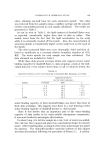
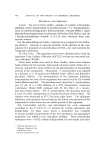
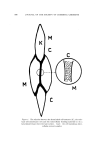
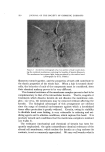
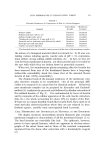
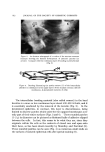
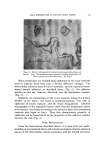
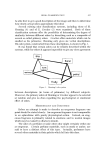
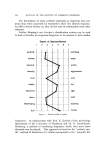
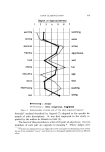
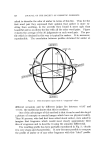
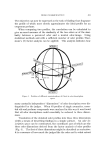
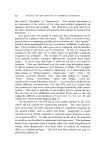
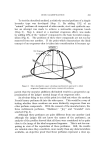
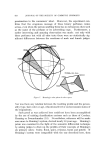
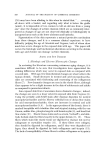
ODOR CLASSIFICATION 521 The objective can now be expressed as the task of finding that fragrance the profile of which most closely approximates the ideal profile for an erogenous perfume. When comparing two profiles, the correlation can be calculated to give an exact measure of the similarity of the two odors or of the simi- larity between a perceived odor and a mental odor-image. Using statistical methods and with a sufficient number of odor profiles Thur- stone's (8) factor analysis can be applied. This analysis indicates how ACTIVITY E VALevet 2,5 '/, Civet 1,0'/. • Civet 0,5% EvAL• I ACTIVITY-_] Figure 5. Position of different concentrations of Civet in odor description space many mutually independent "dimensions" of odor description were dis- tinguished by the judges. When 83 profiles of single aromatics, essen- tial oils and perfume compounds were analyzed in this way it was found that all odor descriptions could essentially be reduced to three dimen- sions. Translation of the obtained odor profiles into these three dimensions yields a means of describing findings in a simple picture. An odor de- scriplion space can be constructed, the coordinate axes of which are the three odor dimensions derived from the factor analysis of odor profiles (Fig. 4). The first of these dimensions might be described as evaluation: it is a measure of how much the judges like the odor and to what extent

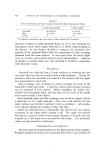
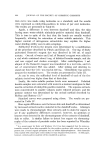
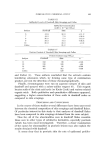
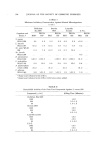
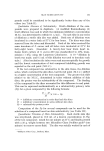
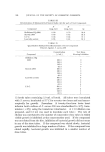
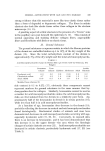
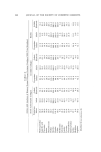
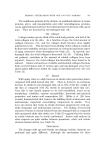
522 JOURNAL OF THE SOCIETY OF COSMETIC CHEMISTS they find it "beautiful" or "harmonious." The second dimension is an expression of the activity of the odor and includes judgments on spiciness, alertness and strength. The third has to do with intensity of the odor freshness, hardness and agressiveness ratings are found in this dimension. Any given odor (the profile of which has been determined) can be indicated by a point in this odor space. This yields a method of com- paring odors (or comparing actually perceived odors and "odor-images") which is more meaningful than the correlation coefficient of odor pro- files: Their position in the odor space can be compared, and the distance between them in this space can be calculated. In Fig. 4 is shown the position in the odor space of 11 odors which are generally considered erogenous by perfumers. The location of each point was calculated from polarity profiles (semantic differentials) obtained from thirty judges. It can be seen that these 11 odors do not have very much in common. They are distributed over the entire odor description space. It will be noticed, for instance, that Tincture of Musk (5%) is judged nearly exclusively in the evaluative dimension it is characterized by high ratings on "disharmonious," "unpleasant," "ugly," "stale." By contrast, Lavender absolute (1%), with high ratings on "happy," "fresh," "young," "interesting," "spicy" and "bright," scores pri- marily in the second dimension, activity. Civet was first smelled in two widely different concentrations, 0.25 and 50%, and it is notable that the position of Civet in the odor space changes drastically with concen- tration. This made it desirable to run further tests to obtain the pro- files of Civet at four additional concentration levels, and in the end values for different concentrations of Civet (0.5, 1.0, 2.5, 5.0, 50, and 100%) were entered in the diagram (Fig. 5). The six points for Civet do not lie very closely together at all, a fact which will not surprise the experienced perfumer. The same observa- tion can be made for other odorants which are considered erogenous by the general public, such as amber and musk. Apparently no single odorant, be it of animal, vegetable or synthetic origin, possesses a clear- cut erogenous effect. In high concentration nearly all of the materials in question are described as unpleasant and aggressive. The perfumer knows from experience that it usually takes very small proportions of strong, often disagreeable, even fecal odors to achieve an erogenous effect in a blended perfume. This fact was first pointed out and ex- plained by Jellinek (9).
Purchased for the exclusive use of nofirst nolast (unknown)
From: SCC Media Library & Resource Center (library.scconline.org)