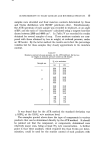
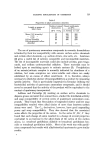
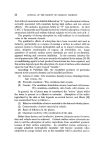
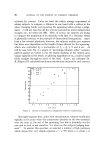
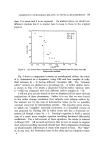
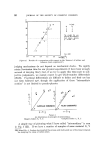
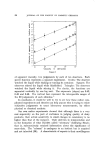
22 JOURNAL OF THE SOCIETY OF COSMETIC CHEMISTS that dodecyl ammonium chloride followed an "L" type adsorption isotherm, normally associated with materiMs having high surface and low solvent affinity. The anionics, in general, follow an "S" type isotherm. At their C.M.C.'s Tamamushi and Tomaki showed the relative adsorption of dodecyl ammonium chloride and sodium dodecyl sulphate to be in the ratio of 8: 1. The property of strong adsorption by solid surfaces is of considerable value to the cosmetic chemist. The qualitative effects of adsorption have been recorded and used in industry, particularly as a means of causing a surface in contact with an aqueous system to become hydrophobic and so to impart corrosion resis- tance, dropwise condensation of vapour, oil wettability, etc. Large quantities of cationic surface active chemicals are used in ore flotation, pigment wetting and corrosion inhibition. In the cosmetic industry the use of quaternaries (10), and more recently ethoxylated fatty amines (11-15) as conditioning agents in hair product formulations has been reported, and this action depends upon the adsorption of a layer of surface active chemical upon the hair fibre to give it good "handle." According to Pickthall (14), the emulsified products of particular interest to the cosmetic chemist can be classified as follows: (1) Lotions or milks: O/w emulsions-beauty creams, cleansing lotions, hair creams, etc. (2) Pourable emulsions: W/o emulsions-hair creams. ($) Creams: O/w emulsions-foundation creams, hand and cold creams. W/o emulsions-emollients, skin foods, cold creams, etc. In general, the oil phase may be considered the "active" phase whilst the water is present as a diluent or extender. Adsorption of the active ingredient by the skin or hair depends on several factors, and Blank (15) has summarized these as follows:m (1) Relative solubilities of active materiM in the skin and vehicle phases. (2) Concentration of active material in vehicle. ($) Rates of diffusion in the phases. (4) Chemical reactivity with constituents of the skin. Before these factors can be effective, however, intimate contact between skin and vehicle must be achieved. Cationic surface active chemicals are able to aid the adsorption of active ingredients from emulsified products because of their surface adsorption. An emulsified system containing a strongly adsorbed hydrophobic emulsifier will become unstable when subjected to a large surface area as the emulsifier will be adsorbed, and so

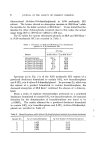
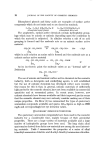
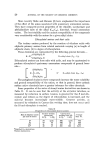
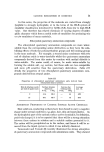
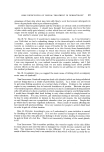
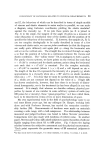
CATIONIC EMULSIFIERS IN COSMETICS 23 its concentration at the oil/water interface will be reduced. The adsorbed hydrophobic film will then be easily wetted by the oil phase, and the water will be displaced and can freely evaporate. The emulsifiers chosen for a product must be selected to produce an emulsion sufficiently stable to withstand normal handling and storage but capable of being "sensitized" on application. THE SELECTION OF SUITABLE EMULSIFIERS Cationic surface active chemicals can be used to produce both o/w and w/o emulsions, but the w/o system favoured by surface active chemicals of low HLB value can be sensitized to a greater degree than o/w emulsions containing high HLB emulsifiers. Approximate HLB values for some cationic emulsifiers are given in Table IV whilst Table V gives the required HLB values for emulsions of several common cosmetic materials. Table IV Approximate HLB values for cationic surface active ',hemicals Material HLB Polyethoxylated C•2 amine ( 5 mol ethylene oxide) ,, C•2 ,,. (15 ...... C•s ,, (15 ...... Didodec'•rl dimethyl ammonium chloride Dodecyl trimethyl ammonium chloride Cetyl ethyl morpholinium ethosulphate 13'0 15.3 16.7 10.0 15'0 25-3O These figures illustrate the following generalizations on HLB values within a chemical series {1) HLB value rises with increased ethoxylation. {2) HLB value rises with increased chain length. A further effect not illustrated here is the rise of HLB value with increasing degree of unsaturation of an alkyl chain. Tal •le V Approximate HLB values re( uired for emulsification (7,16) Material HLB value w/o emulsion o/w emulsion Stearic acid Lanolin (USP anhyd) Cottonseed oil Heavy mineral oil Light mineral oil Petrolatum Beeswax Paraffin 6 8 5 4-5 4-5 4-5 4 4 15-17 10-15 7.5-10 10-12 10-12 10-12 10-16 9-11
Purchased for the exclusive use of nofirst nolast (unknown)
From: SCC Media Library & Resource Center (library.scconline.org)