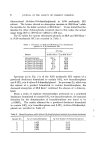
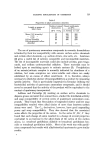
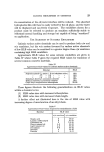
2O JOURNAL OF THE SOCIETY OF COSMETIC CHEMISTS More recently Shibe and Hanson (5) have emphasized the importance of the effect of the anton associated with quaternary ammonium cations. They have compared several properties of the chloride, saccharinate and phthalimidate salts of the alkyl (C•-C,), dimethyl, benzyl ammonium cation. The heat stability and the anionic compatibility of the compounds vary considerably with the anions for a given alkyl chain. Ethoxylated amines and their salts The tertiary amines produced by the reaction of ethylene oxide with aliphatic primary amines form related materials varying (a) in length of aliphatic chain, (b) in degree of ethoxylation. These chemicals are represented by the following general formula:-- CH2CH•O)x H R. R=alkyl chain (C•2 - C•8) Nx(CH•CH•O)y H Ethoxylated amines can form salts with acids, and may be quaternized to produce ethoxylated quaternary ammonium compounds of general form- ula:- R. N--CH 8 X- R----alkyl chain (C•, - C•8) (CH2CH,O)y The polyglycol chains in these compounds increase the water solubility and general compatibility of the cation, so that in general, these cationic surface active chemicals have a greater tolerance for other chemicals. Some properties of the series of stearyl amine derivatives are shown in Table II. It can be seen that the activity at the air/water interface, as measured by reduction in surface tension, is greatest for the 5 mol eth- oxylate and reduces as the degree of ethoxylation is increased, and the material becomes increasingly water-soluble. Greatest activity, as measured by reduction in Canvas disc wetting time, does not occur until the 10 mol ethoxylate is reached. Table II Properties of ethoxylated stearyl amines Surface tension Canvas disc Mol of ethylene oxide (dynes/cm) wetting time (6) Average per mol of amine 0.1% 1.0% 0.1% 1.0% tool. wt. 5* 34 (gell) 360 (gell) 495 5'• 34 33 226 12 482 15• 41 40 157 27 925 50* 49 47 360 360 2470 *Distilled C•s derivatives. iTallow derivatives.

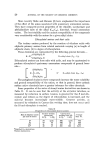
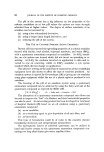
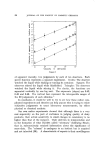
CATIONIC EMULSIFIERS IN COSMETICS 21 In this series, the properties of the molecule are varied from strongly lyophilic to strongly hydrophilic, or in the terms of the HLB system of emulsifier classification introduced by Griffin (7,8), from low to high HLB value. One therefore has related chemicals of varying degrees of hydro- philic character which form a useful series of emulsifiers for producing w/o or o/w emulsions of many materials. Ethoxylated quaternary ammonium compounds The ethoxylated quaternary ammonium compounds are more water- soluble than the corresponding amine derivatives as they have the solu- bilizing effects of both the polyoxyethylene groups and the ionizing groups in the same molecule. For example, a stearyl amine condensate with two mol of ethylene oxide is water-insoluble whilst the quaternary ammonium compounds derived from this amine by reaction with methyl chloride is water-soluble. The amine could, of course, be made water-soluble by forming the soluble salt, e.g. acetate, but these salts are less compatible and more pH sensitive than the quaternary derivatives. Table III details the properties of two ethoxylated quaternary ammonium com- pounds derived from stearyl amine. Table III Properties of ethoxylated quaternary ammonium salts derived from ethoxylated stearyl amines. Mol of ethylene oxide Surface tension Canvas disc Average per tool of quaternary dynes/era wetting time tool. wt. 0.1% 1.0% 0.1% 1.0% 2 41.4 38.3 -- 44 422 15 49.1 48.7 -- 73 994 ADSORPTION PROPERTIES OF CATIONIC SURFACE ACTIVE CHEMICALS Most solid non-conducting surfaces have been found to carry a negative charge under normal conditions, e.g. glass, hair, skin and most plastics. As the hydrophobic part of the cationic surface active chemical is, by definition, positively charged, it is to be expected that there will be a strong attraction between these cations in solution and a suitable surface presented to it. The cation will be precipitated on to the surface, and hence it will be re- moved from the liquid system in which it was initially dissolved. Tamamushi and Tomaki (9) recently illustrated the strong adsorption of quaternary ammonium compounds onto aluminium oxide. They showed
Purchased for the exclusive use of nofirst nolast (unknown)
From: SCC Media Library & Resource Center (library.scconline.org)