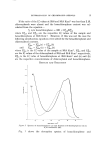
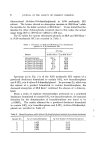
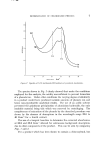
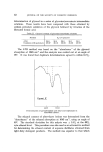
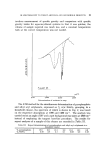
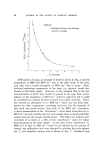
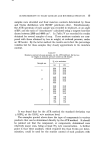
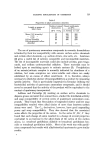
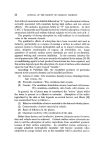
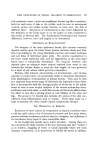
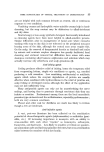
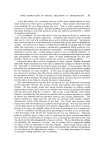
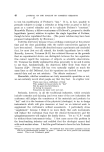
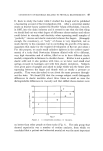
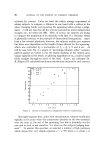
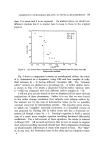
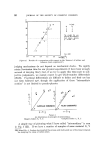
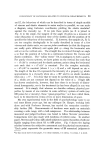
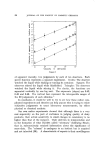
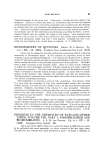
JOURNAL OF THE SOCIETY OF COSMETIC CHEMISTS chloroxylenol (4-chloro-3:5-dimethylphenol) in N/10 methanolic HC1 solvent. The former showed an absorption maxima at 33.8 Kcm -• while the maxima for the latter occurred at 35.8 Kcm-L It was found that the maxima for other chloroxylenols occurred close to this value, the actual range being 35.5 to 35.9 Kcm -• (281.5 to 279 m•). the E} values for various chlorinated phenols at 33.8 and 35.8 Kcm -• in N/10 methanolic HC1 are recorded in Table I. Table I E, x values at 33.8 and 35.8 Kcm -x for chlorinated phenols in N/10 methanolic HC1. Phenol Hexachlorophene 4-Chloro-3:5-dimethyl 4-Chloro-2:3-dimethyl 4-Chloro-2:5~dimethyl 4-Chloro-2:6-dimethyl 2-Chloro-3:5-dimethyl 6-Chloro-3:4-dimethyl El value at 33.8 Kcm -x 138.4 4.05 7.7 20.2 3.2 2.72 21.7 at 35.8 Kcm -x 63.8 95.5 101.0 138.8 98.8 103.5 166.0 Spectrum (a) in Fig. 2 is of the N/10 methanolic HC1 extract of a powdered deodorant formulated to contain 0.5% w/w hexachlorophene and 0.12% w/w 4-chloro-3:5-dimethylphenol. In spectrum (b), which was the extract of a product formulated to contain hexachlorophene, the decreased absorption at 35.8 Kcm -• confirmed the absence of a chloroxy- lenol. From a series of replicate determinations performed on a powdered deodorant, formulated to contain 0.5% w/w hexachlorophene, the standard deviation for the determination of hexachlorophene was found to be 4-0.005%. The results obtained for a powdered deodorant formulated to contain 0.5% w/w hexachlorophene and 0.12% 4-chloro-3:5-dimethyl- phenol are recorded in Table II. Table II Hexachlorophene and 4-chloro-3:5-dimethylphenol content of powdered deodorant Sample No. % w/w hexachlorophene % w/w 4-chloro-3:5-dimethyl phenol 0.472 0.486 0.480 0.487 0.479 0.117 0.119 0.115 0.125 0.120

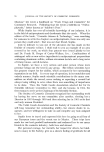
DETERMINATION OF CHLORINATED PHENOLS • o,: o , , • • i , 40 3 8 3 6 34 32 30 WAVELENGTH K ½•'l• I Figure 2 Spectra of N/10 methanolic HC1 extracts of powdered deodorants. The spectra shown in Fig. 2 clearly showed that under the conditions employed for the analysis, the acidity was sufficient to prevent formation of a phenate ion. Under other conditions the varying degree of alkalinity in a product would have produced variable amounts of phenate ion and hence non-reproducible analytical results. The use of an acidic solvent prevented the gelatinous precipitation of aluminium hydroxide, the only insoluble material being talc which was removed by centrifuging. The completeness of extraction of the phenols by the described procedure was shown by the absence of absorptions in the wavelength range 32.0 to 40 Kcm -• for a fourth extract. The use of a tangent base-line to determine the corrected absorbances at 33.8 and 35.8 Kcm -• allowed for extraneous background absorptions due to other components of the product. This can be seen by comparing Figs. 7 and 2. For a product which has been shown to contain a chloroxylenol, but
Purchased for the exclusive use of nofirst nolast (unknown)
From: SCC Media Library & Resource Center (library.scconline.org)