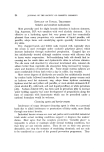
CONSISTENCY OF MATERIALS RELATED TO PHYSICAL MEASUREMENTS 47 and this really does no more than substitute a number for a name, as is sometimes done in the army or in prisons. Ordinal measures are well illustrated by the scoring for firmness dis- cussed above. There is no evidence that the numbers 5- 1 are evenly spaced and we cannot write, for instance, 5-4 = 2- 1 but the order is meaningful (5). Interval scales, as the name implies, presume an equality of interval between the members, e.g. degrees on the Fahrenheit temperature scale, but the zero is arbitrary and sometimes indeterminate. Interval scales cannot be inter-converted by a single multiplication, whereas the highest category, ratio scales, such as lengths, masses, degrees Kelvin, etc., can. Thus, if we ask the old question "Can sensations be measured?" Stevens would reply that it depends on what type of measurement you have in mind. This is, I think an appropriate stage to turn back to the earlier history of this controversial question, though only a very brief outline can be given here and some of the story is doubtless already well known to you [if not, it can be found in a book by Boring (6)]. In 1834 Weber found an empirical experimental law that the just noticeable difference (j.n.d.z•E) in the intensity of a stimulus, say a beam of light, is proportional to the intensity (E) of the stimulus. This is approximately true in many cases and there can be no theoretical objection to it in so far as it works. However, in 1850 (apparently unpublished until 1860) Fechner extended the "law" by making certain assumptions which were strongly challenged by many workers, including Tannery (1875) and later by Bergson (7). Fechner assumed that our consciousness of an increase of stimulus is produced by an increase of sensation (z•S). It is further assumed that equal increases in j.n.d.'s correspond to equal increments of sensation so that z•S = C f(E)' C being a constant. The deltas are then arbitrarily replaced by d's and, assuming Weber's law, we have, by integration, S = C in (E/Q), Q being a constant. This very dubious equation is, unfortunately, often linked with the name of Weber as "the Weber- Fechner law." Tannery and Bergson claimed that sensations are not "quantities" at all and cannot, therefore, be expressed numerically. Delboeuf, in Ghent and later in Liege, added a number of terms to Fechner's equation, mainly to obviate troubles with limiting conditions. He also performed experiments in which he claimed that it was possible

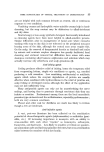
48 JOURNAL OF THE SOCIETY OF COSMETIC CHEMISTS to test his modification of Fechner's "law." It is, in fact, possible to persuade subjects to judge a stimulus as being twice as great or half as great as a control stimulus and so to calculate Fechner's "constant." Meanwhile Plateau, a fellow-countryman of Delboeuf's, proposed a double logarithmic (power) relation to replace the single logarithm of Fechner, though he later repudiated the idea. (The power relation may have been proposed independently by Brentano.) I tell this brief story because it has a striking counterpart at the present time and the close parallelism with the earlier controversies appears to have been missed. Stevens (8) described many experiments and concluded that, for most (but not all) stimuli, the double logarithmic law is valid. Recently, however, Treisman (9-11) has criticized Stevens on the grounds that no experimental device can distinguish between the two equations. One cannot regard the responses of subjects as scientific observations. Dr. Treisman has kindly explained his ideas personally to me and it seems to me that, fundamentally, his objections differ little from those of Tannery (12)*. Stevens (13) has very naturally replied on much the same lines as did Delboeuf, that his 'equations are derived from experi- mental data and are not artefacts. The debate continues! Meanwhile, whether sensations are truly measurable quantities or not, we can certainly record what people say that they feel. In a lighter vein: There once was a craftsman of Deal Who judged all his products by "feel" But he spent his brief leisure In trying to measure Sensations he knew were not real. Seriously, however, in all the traditional industries, which certainly include cosmetics and dairying (and even some of the new industries) the craftsman still judges the consistency of his materials and products by "feel" and it is the business of the physicist (rheologist) to try to design instruments which will give measures at least on an interval scale to supplement the craftsman's ordinal assessments. I particularly stress "supplement" because I think it no more likely that such instruments will replace the craftsman than that the clinical thermometer and the sphygmomanometer will replace the family doctor. Yet no "G.P." would be without these instruments today. I first came across this problem in the bread-making industry and realized that the rheologist cannot deal with such matters alone. I had the good fortune to have the late Professor *Bergson's criticism was rather different. He believed that measurable quantities must be able to be simultaneously present "in space." Stimuli can be so present but sensations cannot. This is not Treisman's point.
Purchased for the exclusive use of nofirst nolast (unknown)
From: SCC Media Library & Resource Center (library.scconline.org)