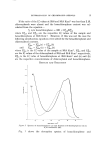
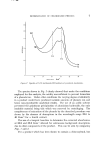
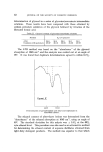
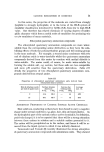
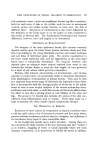
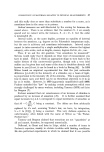
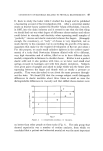
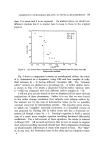
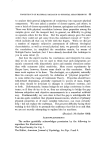
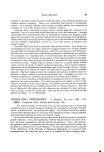
CONSISTENCY OF MATERIALS RELATED TO PHYSICAL MEASUREMENTS 49 D. Katz to study the baker while I studied the dough and he published a fascinating account of his invest. igations (14). After a somewhat similar study on heather honey (assisted by Brother Adam of Buckfast), I moved, in 1937, into the dairy industry and it seemed to me that the first thing we should find out was what degree of difference cheese-makers and others could detect in viscosity and elasticity when squeezing small samples of "perfectly" viscous and elastic materials between the fingers. (Strangely enough, the consistency, or "body" of cheese is very important, not so much directly to the consumer, but in controlling the growth of the micro- organisms that make for the required development of flavour and odour.) For this purpose, we made small cylinders (spheres in the earliest experi- ments) of a truly fluid Newtonian bitumen diluted with oil to different, very high viscosities and of rubber, filled so as to have different elastic moduli, comparable in firmness to cheddar cheese. Rubber is not a perfect elastic solid and it also perishes with time, so we later used small steel springs encased in bandages and with firm plastic end-pieces. Subjects were given pairs of samples and asked to judge which was the firmer after squeezing between the finger and thumb with as steady a pressure as possible. They were also asked to use about the same pressures through- out the tests. We found (15) that the average subject could distinguish differences in elastic modulus about three times as small as were the distinguishable differences in viscosity and that skilled cheese-makers were lO0 8o .a x o • 60 • 40 0 0.5 1.0 log A Figure 1. X compression modulus' ¸ viscosity. 1.5 no better than other people at these tasks (Fig. 1). The only group that showed superiority was a number of routine analysts, from which we concluded that a patient and unhurried mental set was the most important

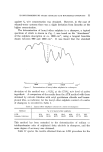
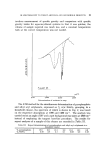
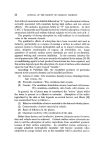
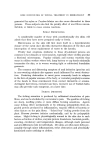
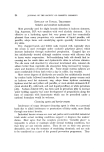
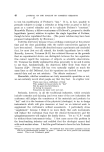
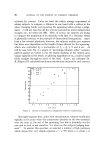
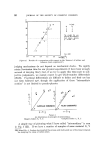
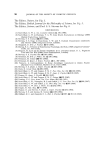
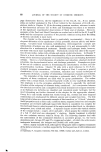
50 JOURNAL OF THE SOCIETY OF COSMETIC CHEMISTS criterion for success. Later we tried the rather strange experiment of asking subjects to compare a bitumen in one hand with a rubber in the other, changing hands and repeating the squeezing before giving a judge- ment. I will not here list all the obvious precautions about temperature changes, etc., for which see (16). Here, of course, our subjects are trying to compare the magnitude of an elasticity with that of a viscosity, which is physically contrary to the principle of dimensional homogeneity. Apart from a few worried physicists, however, the subjects readily gave answers but these were dependent on the length of time allowed for the squeezing, which was controlled by a metronome at to ----- «, 1, 2 and 4 sec. As will be seen from Fig. 2, a graph of "percentage bitumen softer" answers, plotted against nto (where n was the elastic modulus of the rubber) gave unique sigmoid curves which, on plotting logarithms of nto, could be made fairly straight throughout most of the field. (Later, my colleague Dr. R. Harper (17) calculated much more satisfactory analyses for such curves.) lOO 9o •o 7o • 6o z 5o 7o 2O Figure x • I. 0 ,, •" 2.0" ? " 4t, O " i , i i i • x © I•) I I I I I I I , • • i 6,1 6. 3 ½.5 6.7 6.'9 LoG Results of simultaneous comparisons with two compressions. one might suppose that, under such circumstances, subjects would give equality at the point when the compression (strains) on the two materials were the same at the end of the squeezing, but this is definitely not the case and we had to ask ourselves "by what are the subjects judging firm- ness?" To answer this question, we selected a number of high polymers which obeyed the very simple equation , = •0-•tks where, is strain, t is
Purchased for the exclusive use of nofirst nolast (unknown)
From: SCC Media Library & Resource Center (library.scconline.org)