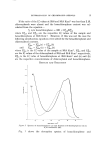
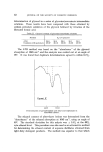
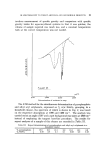
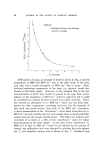
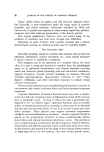
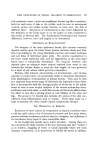
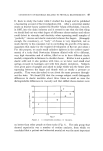
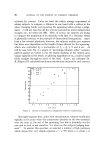
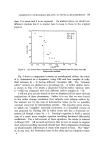
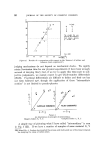
CONSISTENCY OF MATERIALS RELATED TO PHYSICAL MEASUREMENTS 53 and Z, the behaviour of which can be described in terms of simple models of viscous and elastic elements in series and/or in parallel, we can make a diagram, using Cartesian coordinates, plotting the elastic modulus* against the viscosity (7). If we join these points (as X is joined in Fig. 5) to the origin, the tangent of the angie (0) gives us a measure of some relaxation or retardation time of the system and the position of X specifies the behaviour of the material. If, however, the samples (A, B, C) are too complex rheologically to be easily described in terms of a few viscous and elastic units, we can use polar coordinates (so that the diagrams are really quite different) and again plot •/• along the horizontal axis and a/• on the vertical axis. The straight line is rotated through an angle •o so that the position of A lies in a continuum between the viscous and elastic conditions. The "radius vector" OA is analogous to both n and G. For purely viscous systems, we have points on the vertical line such that a + d • e/dt • is constant and for elastic systems, points along the horizontal axis such that a + døe/dt ø is constant. For the complex materials, a + d• e/dtl• is constant (where 1 • 0) and • will depend on sin •o. The length of the line OA represents the intensity of a property (z) which approximates to a viscosity when sin •o = 90 ø and to an elastic modulus when sin •o = 0 ø. It is clear that we must be careful about the dimensions of z, which are not constant but depend on the value of •o. Dingle (23) has shown conclusively, however, that here there is no breach of dimen- sional homogeneity, nor is the treatment (as has been alleged) in any way unsound. It is simply that whereas we describe ordinary physical pro- perties by means of one number in some arbitrary system of units (say 100 poises for a viscosity), these "quasi-properties," as I have called them, have to be described in terms of two or more dimensions of space. My own experimental work in the field of psychorheology came to an end some fifteen years ago, but my colleague Dr. Harper, working both alone and with Professor Stevens, has carried the researches consider- ably further (24). Measurements of hardness were made on materials, covering a wide range, with a ball compressor. The relationship between measured and judged hardness was found to follow Stevens' power-law. Comparisons were also made with loudness of (white) noise. In another paper, Stevens and Guirao (25) asked subjects to assess viscosities of silicone liquids ranging from about 0.1 to 950 poises. Fig. 6 shows the log-log relation between the subjective assessment and the physical measurement. "Each point represents the geometric mean of 20 numerical judgements *In this much more recent paper, G is shear modulus, • is stress, e is strain, k is de/dr.

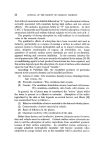
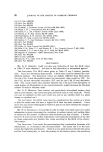
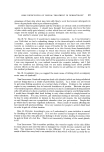
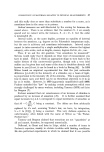
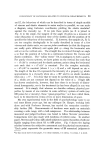
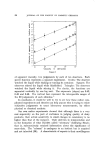
54 JOURNAL OF THE SOCIETY OF COSMETIC CHEMISTS -• 10 4 • i0 3 • 5 I0 • ,-, :3 2 I0 o 5 • 2 I i i i i I0 I0 • 10 3 10 4 I0 • Viscosity in centipoises Figure 6 of. apparent viscosity, two judgements by each of ten observers. Each power function represents a separate experiment. Circles: The observer watched the liquid while shaking or turning its container. Squares: The observers stirred the liquid while blindfolded. Triangles: The observers watched the liquid while stirring it. For clarity, the functions are separated vertically by one log unit. The exponents (slopes) are 0.42, 0.43 and 0.46. The vertical bars represent the interquartile ranges of the 20 judgements of each stimulus." In conclusion, it would be well to try to see how these rather com- plicated experiments and theories can help anyone who is trying to relate subjective judgements to exact laboratory measurements, by either physical or chemical analysis. Our own earlier experiments showed that although there is a very real superiority on the part of craftsmen in judging quality of dairy products, their actual sensitivity to small changes in consistency is no higher than that of the inexpert. Their skill lies in interpretation and in the formation of what Bartlett called "schemata" (following Head) that is, subconsciously retained information about the significance of sense-data. The "schema" is analogous to an instinct but is acquired and not inherited (26). A characteristic of experts is their unwillingness
Purchased for the exclusive use of nofirst nolast (unknown)
From: SCC Media Library & Resource Center (library.scconline.org)