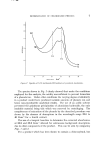
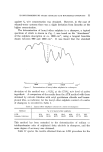
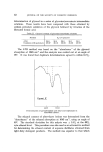
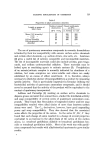
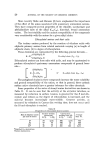
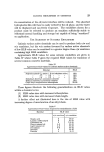
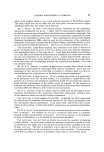
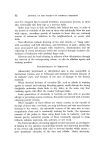
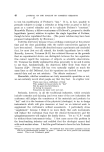
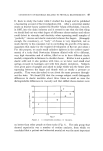
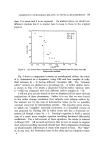
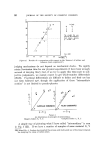
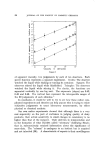
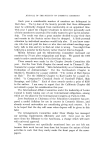
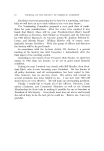
CONSISTENCY OF MATERIALS RELATED TO PHYSICAL MEASUREMENTS 51 time, S is stress and k is an exponent. (In modern times, we should use different symbols but it is simpler here to keep to those in the original papers.) 100 a ot•i•c. •t--I ,. 80 • • • t ,, .• ,, • t• r ,, 60 ß • 40 •o 0 ' ' ' "'"J ' • ....... J .... J .... •---•--,rd -,• .... , 6'0 6'2 6'4 O-O 6'8 7'0 7'2 7'• 10g•e •/t Ak Figur• 3. The dotted lines represent the curves obtained from the data from the compression machine. Fig. 3 shows a comparison between an unvulcanized rubber, the value of k, determined on a rheometer, being 0.50 and four samples of truly fluid bitumen (k = 1) having different viscosities (18). The "bitumen softer" answers are plotted as a percentage (p). A rather similar curve is shown in Fig. 4 in which a plasticine-Vaseline-rubber mixture with k = 0.22 was compared with four different rubber samples (k = 0). I will not give you the details of how we dismissed all the more obvious explanations of these phenomena. Suffice it to say that we were forced to the rather strange conclusion that subjects were judging neither by the amount nor by the rate of deformation under (as far as possible) constant stress but by intermediate entities. The equation given above, to which our "complex" materials conformed, is a simplified version of one proposed by Nutting (19) in which stress also has a fractional ex- ponent (p) though p may be 1. Nutting's equation is itself a special case of a much more complex equation involving fractional differeritial coefficients. For a full account of these equations, the reader is referred to Harper (17). All we need say here is that we saw no reason to suppose that subjects handling materials should base their judgements of firmness on whole-number differentials of strain with respect to time. The "time" is, in any case, the Newtonian time of the clock and our subjective time- o

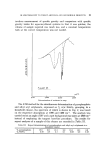
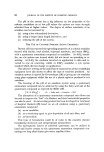
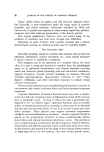
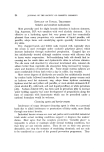
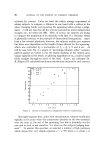
52 JOURNAL OF THE SOCIETY OF COSMETIC CHEMISTS P 100 6.0 6.2 6.4 6.6 6.8 Io x i E] 4 The straight line was f•tted by the method of least squ•res, •gnoring p I0 •,nd 90. Ak = 0.22 Figure 4. Results of a comparison with respect to the 'firmness' of rubber and bitumen (main experiment'). judging mechanisms do not depend on mechanical clocks. We rightly retain Newtonian time for our physical experiments (I have been wrongly accused of denying this!) but, if we try to apply this time-scale to sub- jective judgements, we cannot expect to get whole-number differentials (20,21). Fractional differentials are difficult to define and their use has not been followed up*, though the application of these "intermediate entities" is not limited to psycho-physics. X eY • ii / I COOKDINATE$ • POLA.
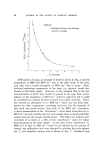
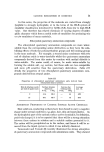
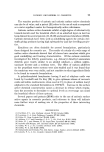
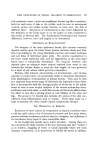
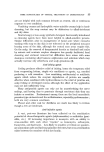
CAKTESIM, IL COORDINATES Figure $. An illustration of principle of intermediacy. Burgers bodies X, Y, Z Complex bodies A, B, C A simple way of picturing what I have called "intermediacy" is seen in Fig. 5 (22). If we have a number of samples of some material X, Y *My friend Mr. A. Graham has inverted the process and made good use of fractional integrals for studying the creep of metal alloys.
Purchased for the exclusive use of nofirst nolast (unknown)
From: SCC Media Library & Resource Center (library.scconline.org)