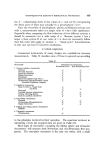
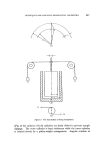
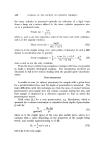
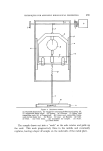
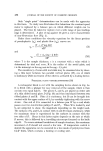
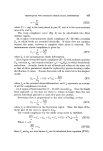
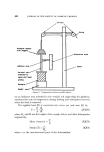
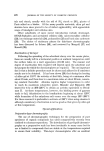
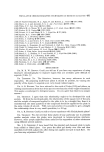
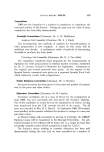
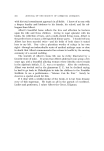
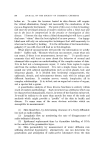
448 JOURNAL OF THE SOCIETY OF COSMETIC CHEMISTS the inner cylinder is measured optically by reflection of a light beam from a lamp via a mirror affixed to the inner cylinder suspension wire on to a graduated scale. Strain (+) -- r•a (II) r• - r• where r• and rs are the respective radii of the inner and outer cylinders, and a is the angular rotation. Shear stress (S) = mgD (III) x(r• + rs) d where m is the weight acting over each pulley of diameter D, and g (981 dynes) is acceleration due to gravity. Creep compliance -- + --r• ax (r• + rs) d = K a (IV) S (r•.- r•) mg m since a and m are the only variables. From the way in which creep compliance changes with time, it is possible to make a detailed rheological analysis. The calculations involved are discussed in full in the section dealing with the parallel plate viscoelasto- meter. PENETROMETERS A needle or cone (or sphere) penetrates the sample with a given force for a predetermined time, and the depth of penetration is measured. The main difficulties with this technique are that the area of contact between penetrometer and sample does not remain constant during the test, and that sample is displaced in a direction opposite to that in which the penetrometer moves. Yield value (So) for a cone penetrometer, e.g. Hutchinson, which is operated by a release mechanism is calculated from depth of penetration (p cm) by S O K• mg - (v) (gm/cm') pn where m is the weight (gms) of the cone plus mobile parts, and n is a constant with a value depending on the properties of the sample being tested, and usually approximating to 2 (8). K• 1 = -cos 2 • cot • (VI) where 2• is the cone angle.

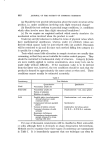
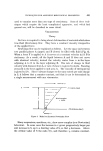
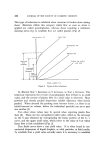
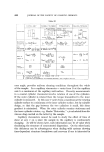
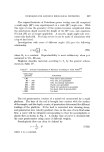
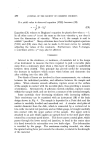
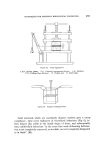
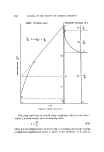
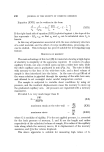
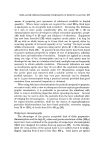
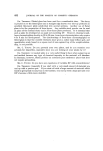
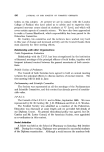
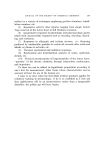
TECHNIQUES FOR ASSESSING RHEOLOGICAL PROPERTIES 449 The original Institute of Petroleum grease testing cone (9) comprised a small angle (30 ø) cone superimposed on a wide (90 ø) angie cone. With this type of cone the geometry of the system becomes complicated when the penetration depth exceeds the height of the 30 ø cone, and equations (V) and (VI) are no longer applicable. A smooth, single angle cone over- comes this fault (10). For long service it can be made of aluminium with a tip of hard steel. Investigations with cones of different angles (11) gave the following relationship where K2 is a constant. Reproducibility is most satisfactory when p is restricted to 7.5 - 20 mm. Haighton classifies materials according to S O by the general scheme shown in Table IV. Table IV Textural Classification of Materials according to Yield Value (lø) Yield value (gm/cm •) Assessment 50 50 - 100 100 - 200 200 - 800 800 - 1000 1000 - 1500 1500 Very soft to just pourable Very soft, not spreadable Soft, but already spreadable Plastic and spreadable Hard, but satisfactory spreadable Too hard, limit of spreadability Too hard The rod penetrometer consists of a metal rod surmounted by a small platform. The base of the rod is brought into contact with the surface of the sample, and the depth, or rate, of penetration determined for different loadings of the platform. If the load is converted into shearing stress, and penetration into velocity gradient, then, in the case of non-Newtonian flow, a curve will be obtained corresponding to that for pseudoplastic or plastic flow as shown in Fig. 2. A similar type of curve is obtained with the cone penetrometer using cones of different weights. Pseudoplastic flow can often be defined by 1 V -- S n (VIII) where n is a constant.
Purchased for the exclusive use of nofirst nolast (unknown)
From: SCC Media Library & Resource Center (library.scconline.org)