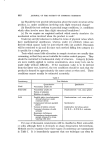
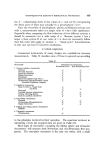
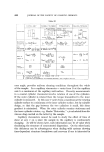
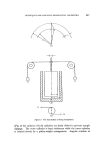
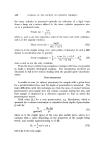
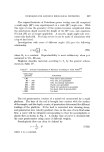
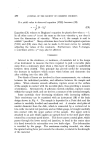
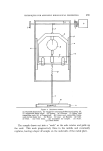
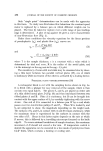
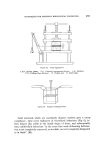
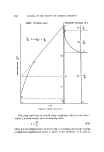
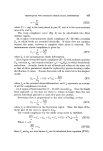
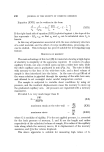
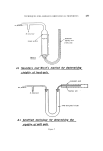
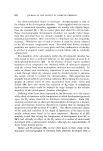
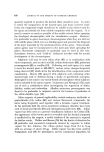
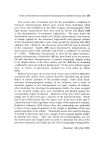
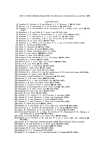
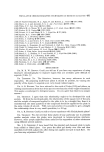
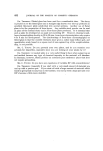
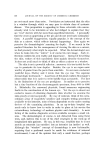
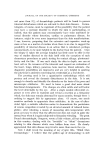
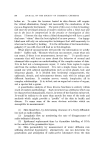
TECHNIQUES FOR ASSESSING RHEOLOGICAL PROPERTIES 443 the S - v relationship down to low values of v, and not by extrapolating the linear part of what may actually be a pseudoplastic curve. Since the viscosities of pseudoplastic, plastic, and dilatant systems vary with v, measurements taken at a single value of v have little significance. Especially when comparing the flow behaviour of two different systems •q should be measured over a wide range of v. Because system 1 has a larger •q than system B at one value of v it does not necessarily follow that this order will apply at another v. "Single point" determinations in this case can lead to incorrect conclusions. A critical comparison Commercial instruments of many designs are available for viscosity measurements. Table II classifies some of those in general use according Table II Viscometer Suitability for measuring . New'tonian Flow Non-Newtonian Flow 1. Coaxial cylinder viscometers Stormer Portable Ferranti Epprecht Rheomat Haake Rotovisko Brookfield Merrill-Brookfield High Shear Weissenberg Rheogoniometer (Farol Research Engineers, Bognor) 2. Capillary viscometers Glass U-tube (a', Single bulb (b) Multi Redwood Variable pressure plastometer Techne vibrating piston Insfrom capillary rheometer 3. Cone-Plate viscometers Ferranti Weissenberg Rheogoniometer Haake Rotovisko 4. Falling and rolling sphere viscometers H6ppler $. Ultrasonic viscometer Ultraviscoson to the principles involved in their operation. The equations involved in calculating •q from the acquired data are given in Table III. Most types of viscometer, excepting the falling sphere and ultrasonic viscometers, will measure both Newtonian and non-Newtonian flow pro- perties. The cone-plate viscometer is the only one which, with a small

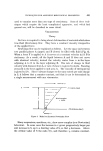
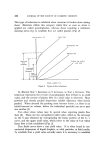
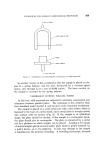
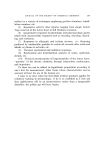
444 JOURNAL OF THE SOCIETY OF COSMETIC CHEMISTS Table III 1 ' •' RADIANS•EC, NEWTONIAI4 I I RATE OF •= • SHEAR PR • - 3G ........ '-- Gz=•TRAPOtATEO VALU[ • TO•U[ •0• cone angle, provides uniform shearing conditions throughout the whole of the sample. In a capillary viscometer v varies from 0 at the capillary axis to a maximum at the capillary wall surface. Viscosity measurements in a coaxial cylinder viscometer involve rotation of one of the cylinders. If the outer cylinder is rotated then the torque transmitted to the inner cylinder is measured. In this case v varies from a maximum at the rotating cylinder surface to a minimum at the inner cylinder surface, but by suitable design, so that the gap between the two cylinders is small, this shear gradient is minimized. When the outer cylinder remains stationary and the inner cylinder rotates, e.g. Haake "Rotovisko," • is calculated from the viscous drag exerted on the latter by the sample. Capillary viscometers cannot be used to study the effect of time of shear at any v on Yl since the sample in the capillary is continuously changing. As will be shown later, such information can be of value when elucidating the structure of concentrated dispersions. On the other hand, this deficiency can be advantageous when dealing with systems showing time-dependent structure breakdown and recovery if one is interested in
Purchased for the exclusive use of nofirst nolast (unknown)
From: SCC Media Library & Resource Center (library.scconline.org)