49O JOURNAL OF THE SOCIETY OF COSMETIC CHEMISTS (85) (86) (87) (88) (s9) (90) (91) (92) (93) (94) (95) (96) (97) (98) (99) (100) (101) (102) (51) Metz, H. Naturwlss. 48 569 (1961). (52) Tate, M. E. and Bishop, C. T. Can. J. Chem. 40 1043 (1962). (53) Honegger, C. G. Helv. Chim. Acta 45 281 (1962). (54) Brenner, M. and Niederwieser, A. Experientia 1{1 378 (1960). (55) Stanley, W. L. and Vannier, S. H. J. Assoc. Offic. Agr. Chemists 40 582 (1957). (56) Geiss, F. and Schlitt, H. Naturwiss. 50 350 (1963). (57) Brenner, M., Niederwieser, A., Pataki, G. and Fahmy, A. R. Experientza 18 101 (1962). (58) Muller, K. H. and Honerlagen, It. Mitt. Deut. Pharm. Ges. 30 202 (1960). (59) Harthon, J. G. L. Acta Chem. Scan& 15 1401 (1961). (60) Malins, D.C. and Marigold, H. K. J. Am. Oil Chemists' Soc. 37 576 (1960). (61) Stahl, E. Arch. Pharm. g93/{15 531 (1960). (62) Honegger, C. G. Helv. Chim. Acta. 44 173 (1961). (63) Henkel. H. G. and Ebing, W. J. Chromatog. 14 283 (1964). (64) Stahl, E. and Kaltenbach, U. J. Chromatog. 5 458 (1961). (65) Marigold, H. K. and Kammereck, R. Chem. Ind. London 1032 (1961). (66) Rybicka, S. M. Chem. Ind. London 308 (1962). (67) Fiori, A. and Marigo, M. Nature 18• 943 (1958). (68) Brown, T. L. and Benjamin, J. Anal. Chem. 8{i 446 (1964). (69) Ertel, H. and Horner, L. J. Chromatog. 7 268 (1962). (70) Beroza, M. J. Agr. Food Chem. 11 51 (1963). (71) Yamamura, J. and Chiba, M. Proc. Japan Acad. 38 129 (1962). (72) Petrowitz, H-J. Chemiker-Ztg. 85 867 (1961). (73) Conkin, R. A. Residue Reviews {1 136 (1964). (74) Walker, K. C. and Beroza, M. J. Assoc. O.•c. Agr. Chemists 4{1 250 (1963). (75) Stammbach, K., Delley, R., Surer, R. and Szekely, G. Z. Anal. Chem. 19{1 332 (1963). (76) Chiba, M. and Morley, H. V. J. Assoc. O.•c. Agr. Chemists 47 667 (1964). (77) Katz, D. J. Chromatog. 15 267 (1964). (78) Spickerr, R. G. W. Chem. Ind. London 561 (1957). (79) Salo, T., Salminen, K. and Fiskari, I(. Z. Lebensm. Untersuch. Forsch. 117 369 (1962). (80) Blinn, R. C. J. Assoc. Offic. Agr. Chemists 4{1 952 (1963). (81) Steller, W. A. and Curry, A. N.J. Assoc. O.•c. Agr. Chemists 47 645 (1964). (82) Mitchell, L. C. J. Assoc. O.•c. Agr. Chemists 41 781 (1958). (83) Abbott, D.C., Egan, H., Hammond, E. W. and Thomson, J. Analyst 89 480 (1964). (84) Yamamura, J., Chiba, M., Obara, S. and Susaki, S. Kagaku Keisatsu Kenkyusho Hokoku 15 321 (1962), Chem. Abstr. 58 14635 (1963). Abbott, D.C., Egan, H. and Thomson, J. J. Chromatog. 1{1 481 (1964). Getz, M. E. and Friedman, S. J. J. Assoc. Q•c. Agr. Chemists 4{1 707 (1963). McKinley, W. P. and Johal, P.S. y. Assoc. O.•c. Agr. Chemists 4{1 840 (1963). Bunyan, P. J. Analyst 89 615 (1964). Mottier, M. and Potterat, M. Mitt. Lebensmittel Hyg. 43 123 (1952). Barrolier, J. Naturwiss. 48 404 (1961). Lichtenberger, W. Z. Anal. Chem. 185 111 (1962). Bennett, R. D. and Heftmann, E. y. Chromatog. 9 348 (1962). Getz, H. R. and Lawson, D. D. J. Chromatog. 7 266 (1962). Hilton, J. and Hall, W. B. J. Chromatog. 7 266 (1962). Gordon, H. T. Science lg8 414 (1958). Zeitman, B. B. J. Lipid Res. 5 628 (1964). Abelson, D. Nature 188 850 (1960). Sprenger, H. E. Z. Anal. Chem. 199 338 (1964). Eisenberg, F. J. Chromatog. 9 390 (1962). Purdy, S. J. and Truter, E. V. Proc. Roy. Soc. London Ser. B. 158 536 (1963). Deters, R. Chemiker Ztg. 8{1 388 (1962). Giinshirt, H. and Morianz, K. Arch. Pharm. g93/{15 1065 (1960).

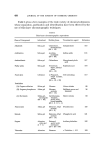
THIN-LAYER CHROMATOGRAPHIC TECHNIQUES IN RESIDUE ANALYSIS 491 (103) (104) (105) (106) (107) (108) (109) (110) (111) (112) (113) (114) (115) (116) (117) (118) (119) (120) (121) (122) (123) De Faubert Maunder, M. J., Egan, H. and Roburn, J..dnalyst 89 157 (1964). Marco, G. J. and Jaworski, E.G. J. Agr. Food Che•n. 12 305 (1964). Wilde, P. F. Lab. Pract. 13 741 (1964). Milleft, M. A., Moore, W. E. and Seaman, J. F. A•al. Chem. 3{I 491 (1964). Fowler, t-I. D. Nature 1{18 1123 (1951). Privett, O. S. and Blank, M. L. J. Lipid Res. 2 37 (1961). Squibb, R. L. Nature 199 1216 (1963}. llaus, R. J. Chromatog. 1{1 311 (1964). Seher, A. Nahrung 4 466 (1960). Purdy, S. J. and Truter, E. V. Chem. Ind. London 506 (1962). Purdy, S. J. and Truter, E. V. Analyst 87 802 (1962). Aurenge, J., Degeorges, M. and Normand, J. Bull. Soc. Chirn. France 1732 (1963). Waldi, D., Schnackerz, I. and Munter, F. J. Chromatog. {1 61 (1961). Fischer, R. and Lautner, H. Arch. Pharm. 294 1 (1961). Seher, A. Fette Seifen. Anstrichmittel {11 345 (1959). Morris, L. J., Holman, R. T. and Fontell, t. J. Lipid Res 2 68 (1961). Wollenweber, P. J. Chromatog. 7 557 (1962). Peereboom, J. W. C. J. Chromatog. 4 323 (1960). Van Dam, M. J. D. J. Chromatog. 4 26 (1960). Pastuska, G. Z. Anal. ½hem. 179 427 0961). Seher, A. Mihrochim. Acta 398 (1961). DISCUSSION DR. •V[. lq. W. ]BROWN: Could you tell me if you have any experience of using thin-layer chromatography to separate sugars that are normally quite difficult to separate [Table I] ? DR. THOMSON: No. The literature, however, has many references to such separation. ]By preparing multi-band plates it should be possible, by varying the polarity of the layers, to separate even very closely related sugars. DR. A. R. ROGERS: YOU have referred to the work of Truter (112) and others, on relating some function of the size of the spot to some function of the weight of material. This seems a counterpart to biological assays. Do you agree that there is no unique answer ? DR. THOMSON: I agree that this relationship ought to be developed for each system. If, from the developed plate, the relationship of the square root of the area and the weight of compound applied to the plate is to be a straight line, then it is essential that the same quantity of the compound should be applied to the plate in the same volume of solvent. With care and practice it is possible to get a straight line relationship down to very small quantities, i.e. 0.5 DR. A. R. ROGERS: Could you tell us of your experience with Kodak plastic plates ? DR. THOUSON: We did not find these plates of any particular use in pesticide residue analysis where the plates were developed in hexane:acetone mixtures. However, other people might find them useful for the separation of other substances using different solvent systems. MR. J. D. Ca•smR•: I have heard that the simplest and cheapest plate is made from reeded or fluted glass. One pours the silica gel slowly over this and then smoothes it off with a glass rod after drying one applies one spot to each flute. Do you have any experience of this ?
Purchased for the exclusive use of nofirst nolast (unknown)
From: SCC Media Library & Resource Center (library.scconline.org)