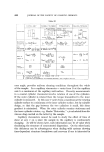
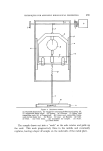
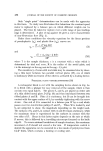
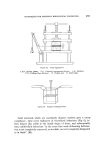
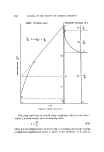
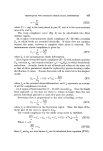
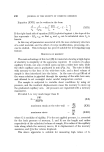
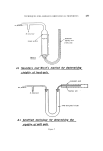
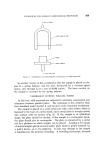
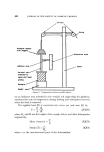
TECHNIQUES FOR ASSESSING RHEOLOGICAL PROPERTIES 461 The data can now be treated in the same way as creep compliance data (Section 4) by plotting T/, against t, but the calculation of viscosity has to be modified since compression produces viscous flow in more than one direction. An approximate correction can be achieved by multiplying the calculated viscosity by 2,:(Ho)•/A. Calculated parameters are lower than those derived from creep compliance since the compression technique causes more structural alteration to the sample. The weight required to give a reasonable compression should be determined by trial and error prior to carrying out the main tests. In a cruder form of the present test, the rate of compression is not determined, but only the total compression, and overall recovery, after a suitable time e.g. 3-5 min. OTHER RI-IEOLOGICAL TECHNIQUES The other, more sophisticated, procedures listed in Table I for assessing the consistency of solids require more complex equipment and are more time-consuming. They are suited only to basic research. Ferry (21•) reviews these methods in some detail. CONCLUSIONS It is often possible to use more than one technique to measure the consistency of any material. However, the techniques employed may not all measure the same component of texture, and this should be appreciated when attempting to correlate the various groups of data. For example, ease of spreadability arises from rapid deformation and structural break- down. Firmness depends on the ability to resist static, or virtually static, loads, so that it is related to very slow deformation. Thus, firmness and spreadability represent quite different attributes of the textural quality described broadly as consistency. Penetrometers, and shear or com- pression under small loads, measure firmness. Extrusion, and other methods involving appreciable structural breakdown, measure spread- ability. (Received: 1st september 1965) REFERENCES (1) Roscoe, R. in J. J. Hermans Ed. Flow .Properties of Disperse Systems 1 (1953) (North Holland Publishing Co., Amsterdam). (2) Houwink, R. Elasticity, Plasticity and Structure of Matter (1958) {Dover Publications Inc. New York). (3) Van Wazer, J. R., Lyons, J. W., Kim, K. Y. and Colwell, R. E. "Viscosity and Flow. Measurement" (1963) (Interscience Publishers, London). (4) Scott-Blair, G. W. and Oosthuizen, J. C. Brit. J. Appl. Phys. 11 332 (1960).

462 JOURNAL OF THE SOCIETY OF COSMETIC CHEMISTS (5) Williams, J. c. and Fulmer, E. J. J. Appl. Phys. 9 760 (1938). (6) McKennell, R. Anal. Chem. 28 1710 (1956). (7) Sherman, P. J. Soc. Cosmetic Chemists 111 591 (1965). (8) Rebinder, P. A. and Semenenko, N. N. Doklady Akad. Nauk. SSSR, tt4 835 (1949) (9) American Society for Testing Materials, ASTM 5-25 D217-52T. (10) Haighton, A. J. J. Am. Oil Chemists Soc. 311 345 (1959). (11) Sambuc, E. and Naudet, M. Rev. Franc. Corps Gias 11 10 18 (1959). (12) Herschel, W. H. and Buckley, R. Kolloid Z. 39 291 (1926). (13) Green, H. Ind. Eng. Chem. Anal. Edn. 13 632 (1944). (14) Green, H. Industrial Rheology and Rheological Structures Chapter 9 (1949) (Chapman and Hall, London). (15) Wood, J. H., Giles, W. H. and Catacalos, G. J. Soc. Cosmetic Chemists 15 564 (1964). (16) Autard, P. to be published. (17) Kolbanovskaya, A. S. and Mikhailov, V. V. Colloid J. U.S.S.R. 23 606 (1961). (18) Van Holde, E. K. and Williams, J. w. J. Polymer sci. 11 243 (1953). (19) Fredrickson, A. G. Principles and Applications of Rheology (1964) (Prentice-Hall Inc., New York). (20) Saunders, P. R. and Ward, A. G. Proc. 2nd Intern. Congr. Rheology 284 (1954). (21) Scott-Blair, G. W. and Burnett, J. Lab. Pract. 11 570 (1957). (22) Ben-Arie, M. M. J. Polymer Sci. 17 179 (1955). (23) Szczesniak, A. S. and Farkas, E. ]. Food Sci. 27 381 (1962). (24) Prentice, J. H. British Food Manufacturers Research Association Research Report No. 69 (1956). (25) Ferry, J. D. in F. Eirich Ed. Rheology, Theory and Applications 2 433 (1958) (Academic Press, New York). DISCUSSION MR. A. Mogs: When one establishes with the aid of a viscometer the rheogram of a non-Newtonian fluid, for example pseudoplastic, can one tell from a graphical interpretation, or by calculation, the viscosity of this fluid at rest, i.e. for a rate of shear equal to zero, or for very low stresses such as those induced by solid particles settling in the vehicle? THE LECTURER: No, because it could well be that the pseudoplastic at rest is in fact not showing any viscosity, it might only have elasticity. A pseudoplastic at rest system consists of particles, or individual components, which are linked together, and as the rate of shear is increased this attraction is progressively broken down until eventually each of the particles acts independently, and simple Newtontan flow prevails. The structure at zero rate of shear is, however, quite different. There- fore by measuring the condition where there is complete breakdown and independent flow of particles, one obviously cannot get any information of the stationary structure where one has interaction and linkages between the particles. MR. Mogs: Could you tell me if a particular method exists to investigate the structure of sediments of flocculated particles in coarse suspensions? THE LECTURER: One of the methods is described under the heading of "Study of Stationary Structure" (page 446). This gives a simple method, involving a quite easily designed coaxial cylinder viscometer, for studying the elasticity of the structure in the steady state where there is linking between the particles. If one does not want to become so academic there is another method which can be carried out with a suitable commercial viscometer, where one first of all subjects the system to very high rate of shear to break down all the structure and get Newtontan flow, and one can then measure the rate of recovery of the structure at a very much lower rate
Purchased for the exclusive use of nofirst nolast (unknown)
From: SCC Media Library & Resource Center (library.scconline.org)