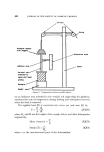
476 JOURNAL OF THE SOCIETY OF COSMETIC CHEMISTS spots across the chromatoplate, a suitably drilled template, usually con- structed of a transparent plastic material, is often used both as a guide and to protect the surface of the layer. The line of spots so applied should be about 15 to 20 mm from one edge of the carrier plate and parallel to it, individual spots being at least 1 cm apart. The line should also be per- pendicular to the direction of spreading to avoid possible unevenness in thickness across the layer. Care must be taken not to penetrate the layer with the tip of the applicator or irregular shaped spots are liable to result on developing tlxe chromatogram (45). In order to maintain the desired compactness (0.5 cm) of the origin spots, Mangold (27) advised the use of a stream of nitrogen to ensure rapid evaporation of the solvent from the plate, while Miller and Kirchner (46) employed a low temperature hot-plate for the same purpose. Ritter and Meyer (47) have mechanized the operation of spotting the samples on to the layer. They designed a syringe which traverses the chromatoplate, applying controlled doses of the solution as required a similar "streak" applicator was used by Coleman (48). Morgan (49) pro- duced a multiple capillary device for the simultaneous application of many solutions to a single chromatoplate Bark et al (50) found that such rapid spotting techniques improved R F reproducibility. As alternative modes of spotting, Metz (51) has used a system of elution from a filter paper triangle, while Tate and Bishop (52) described the use of a wire loop such as is employed for bacteriological purposes. Although the application of circular spots is most often recommended, Honegger (53) advocated that the sample should be applied as a thin band, about 1 cm long. Techniques of this nature are especially suitable for extracts of residues which have not undergone a very thorough clean-up process and in which the ratio of co-extractives to residue is rather high. The load of material which may be successfully applied to the chromato- plate is limited by the layer thickness on one hand and by the sensitivity of the visualization system on the other. Generally speaking, amounts of material in the range 0.5 to 10 [•g may be chromatographed on 250• thick layers to give clearly defined regular spots with little or no streaking. Where large amounts are encountered it is advisable to dilute the extract further and to repeat the chromatogram. Variable R F values have been observed where overloading of the adsorptive capacity of the layer has occurred (54). In the case of purely preparative thin-layer chromato- graphy, however, this factor is frequently less important than in diagnostic work and large loads may then be safely used.

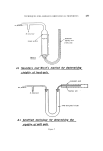
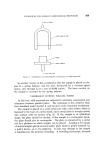
THIN-LAYER CHROMATOGRAPHIC TECHNIQUES IN RESIDUE ANALYSIS 477 Development techniques Thin-layer chromatoplates are normally developed by means of an ascending mobile solvent, the plate being held in an approximately vertical position. Descending- solvent chromatographic techniques are reserved for the separation of substances of low R F values, extended runs being obtained by allowing excess solvent to drip from the bottom of the chromatoplate (55). Horizontal development may also be used but since a wick of some sort is required to maintain the supply of the mobile solvent, this mode is somewhat more difficult to apply. There are many factors governing the successful development of a thin-layer chromatoplate. To ensure even running of the solvent front it is advisable to remove adsorbent from both side edges of the plate, leaving about 5 mm of clear carrier plate. If many samples are spotted closely across the plate it may also be necessary to rule channels between each pair of adjacent spots in order to ensure that no cross contamination can occur should a sample contain an unduly large amount of residue. The mobile phase chosen for the development will depend upon the nature of separation required, and also upon the activity of the adsorbent material. When dealing with a new or unknown compound, preliminary tests should be made using an active adsorbent together with a non-polar solvent such as hexane. Successive small proportions of a polar solvent may then be added as necessary to obtain the required R F value or degree of resolution if a mixture is being studied. Microscope slides bearing layers produced by a spray technique are very suitable for tests of this nature. Development by the ascending-solvent technique is obtained by placing the prepared chromatoplate bearing the sample spots into a tank contain- ing the chosen solvent in such a way that the origin line is parallel to the solvent surface and about 1 cm above it, i.e. a depth of immersion of about 0.5 to 1 cm is obtained. The tank should be sealed by some suit- able means, a well-fitting ground glass cover being frequently employed. Development is then usually allowed to proceed at ambient temperature until the solvent front has traversed a fixed distance or has taken a certain time. It is frequently recommended that the tank should be lined with filter paper dipping into the mobile solvent and should be left to stand for at least one hour before inserting the chromatoplate. Lining the tank in this way serves to ensure that the solvent and its vapour quickly reach equilibrium within the confines of the chamber, a state which assists in maintaining a level solvent front across the layer (14).
Purchased for the exclusive use of nofirst nolast (unknown)
From: SCC Media Library & Resource Center (library.scconline.org)