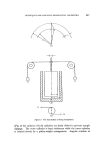
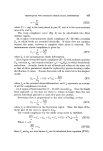
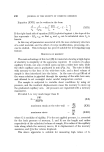
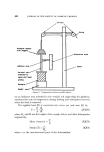
474 JOURNAL OF THE SOCIETY OF COSMETIC CHEMISTS ratio, by applying a series of spots of the material under examination across the plate from reagent A to reagent B and developing in such a way that each spot migrates along a lane of constant composition. By examination of such chromatograms a suitable admixture may be chosen which will effect the desired separation. Preparation and application of sample extract Extraction and clean-up Thin-layer chromatographic procedures are, in general, much more tolerant of co-extracted materials than are paper or gas-liquid chromato- graphic systems. The intrinsic clean-up properties of the layer materials most frequently employed, silica gel and alumina, render minimal the amount of purification of the extract required. Morley and Chiba (39) have proposed a method for the direct thin-layer chromatography of organo-chlorine pesticide residues in some plant extracts without prior clean-up, samples showing possible pesticide content then being further examined by gas-liquid chromatography. This system simplifies the pro- cedure greatly, eliminates some possible sources of pesticidal loss and extraneous contamination, and allows the rapid screening of a large number of samples. Unfortunately its application is rather limited although the introduction of an acetonitrile-hexane partition procedure as a clean-up improved the chromatoplate's background and allowed the method to be used for a wider range of compounds. For samples of vegetable origin, the extraction and clean-up procedure of Goodwin, Goulden and Reynolds (40) is often suitable when organo- chlorine pesticides are under examination. Extraction with acetone followed by partition into hexane, after adding sodium sulphate solution, yields a solution sufficiently clean for gas-liquid or paper chromatography and well suited for application to a thin-layer chromatoplate. When examining samples of waxy vegetables or ripe fruit in this way, the extracts are not suitable for the former two techniques but may still be used for thin-layer chromatography. Organo-phosphorus pesticide residues may be suitably extracted from vegetable tissue with a mixture of ethyl methyl ketone and hexane (3 + 2 V/v ) (41). Dinitrophenol herbicides have similarly been extracted with ethyl methyl ketone: ether, 3 q- 2 (36). For the efficient extraction of pesticides from fatty materials a solvent such as hexane is essential. This, of course, also dissolves a considerable amount of the fat and although thin-layer chromatography is fairly tolerant of vegetable co-extractives, fatty or waxy materials may affect

THIN-LAYER CHROMATOGRAPHIC TECHNIQUES IN RESIDUE ANALYSIS 475 the observed R F value of the chromatographed pesticide usually a reduc- tion of this value is noticed. Organo-chlorine pesticide residues after extraction from animal produce have been cleaned-up for gas-liquid chromatographic examination by means of a dimethylformamide (DMF) partition process, followed by passage through an alumina or magnesia column (42). A similar clean-up process is suitable for thin-layer chromato- graphic purposes but the columnar clean-up stage may usually be omitted. Similar partition processes using acetonitrile (43) and dimethylsulphoxide (44) have also been used for this purpose. In general it is the total load of material that is to be applied to the chromatoplate at one point that governs the thickness of the layer required for efficient chromatographic clean-up. For clean extracts the usual layer thickness of about 250[• is adequate for preparative and clean-up purposes 500• or 1 mm thickness is more usual as previously described. The amount of previous clean-up required may therefore be related, in part, to the availability of spreading apparatus capable of producing layers of various thickness. Application of the sample extract In order to obtain accurate and reproducible thin-layer chromatograms a few simple rules must be observed during the application of the sample extract to the adsorbent layer. The nature of the solvent used for the final solution of the extract to be applied to the plate is very important. In order to ensure that the size of the spots shall be as compact as possible, the chosen solvent should be of as low a polarity as is consistent with good solubility of the pesticide. This is particularly important when only very dilute solutions are available, when it may be necessary to apply the extract repeatedly to one spot in order to ensure sufficient material for dear visualization. Such "over-spotting" is liable to induce radial chromato- graphy at the origin when polar solvents are involved. The solvent should also be readily volatile yet not of so low a boiling point that standard solutions cannot be maintained in constant concentration or that evapora- tion, with consequent deposition of the dissolved material, occurs while within the applicator. Solvents with boiling points in the range 40-60øC are usually preferred whenever possible. The sample solution may be applied to the layer surface by gently touching it with a filled calibrated capillary or micro-pipette or by means of a micro-syringe of suitable capacity volumes of the order of 1 to 15 [•1 per spot are preferred. To aid in the accurate alignment of a series of
Purchased for the exclusive use of nofirst nolast (unknown)
From: SCC Media Library & Resource Center (library.scconline.org)