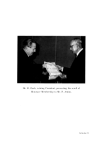
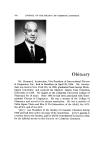
5O4 JOURNAL OF THE SOCIETV OF COSMETIC CHEMISTS with his total commitment approach in all fields. I know of no one with a deeper loyalty and kindness to his friends, his school, and his col- leagues than Albert. Albert's beautiful home reflects the love and affection he bestows upon his wife and three children. Living in regal splendor with his books, his collection of hats, and a multi-storied living room, Albert is the perfect host at many a distinguished dinner party. I should tell you Albert has been married twice--and his bride of both times is seated here to my left. Bea--also a physician worthy of eulogy in her own right--through an indescribable series of medical mishaps came so close to death that Albert commemorated her return to health by the moving ceremony of a second wedding. The warmth of Albert's home life can be richly illustrated by a favorite story of mine. It seems that Albert addressed your group a few years ago, and a beautiful alluring woman whose identity must remain in the algebraic initials, Z. Z., was a co-speaker. After the conference, Albert was invited out by the glamorous Z. Z., but he declined saying he had to go back to Philadelphia to take his children to the Franklin Institute to see a performance--"Science Can Be Fun." Surely he deserves a special award for this. If I close with a wistful stroke of the brush, it is but from dreamy envy of this superman. He leads us all in the pursuit of excellence. Ladies and gentlemen, I salute Albert the Great, Kligman.

JOURNAL OF THE SOCIETY OF COSMETIC CHEMISTS 505 Blind Man Dermatology A.M. KLIGMAN, M.D., Ph.D.* Presented at the Literature Award Luncheon, May 10, 1966, New York City The reader will not likely discern the intent of this little piece from the title. A sampling of my colleagues' guesses showed that I had succeeded in keeping them in the dark. Influenced by my past history in public speaking, they generally surmised that I was going to denounce dermatologists for being "blind," adding thereby a new dimension to the better known deficiencies of this sub-order of medical specialists. Neither I nor any other informed person can deny that dermatologists have keen eyes, though in some instances there is controversy concerning the adequacy of the connections between the retina and the brain. No, my sermon is not about sins on skin but secrets about skin. Dermatologists are fond of pointing out that the skin is the largest and most visible organ in the body. Every recess can be minutely examined, not only with the eyes but with the fingers as well. For those who enjoy looking and touching, the skin is a playground. Our concern is more serious. How much learning, even at the elementary level of description, is possible in a school based on looking and touching ? However accessible the skin, this seeming advantage has not elevated dermatology to a premier position in biologic science. Indeed, this high visibility is, in my view, not a munificence but in fact a misfortune of the first magnitude. The skin is too obvious and too familiar. Just as it is the forbidden which excites the greatest curiosity, it is the hidden, the concealed which stirs the mind. What is inaccessible is challenging easy seeing is sedating. Knowledge seems to be proportional to the barriers standing in the way of its acquisition. If size and accessibility were advantages, we should know little about those tiny tissues, the adrenal and pituitary, about which we probably know the most. Dermatologists are wont to utter other propagandistic pronounce- ments which have the sound of validity but which, like most clich•s, * Duhring Laboratories, University of Pennsylvania, Philadelphia, Pa.
Purchased for the exclusive use of nofirst nolast (unknown)
From: SCC Media Library & Resource Center (library.scconline.org)