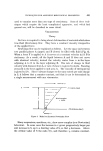
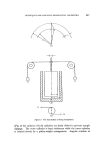
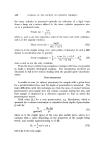
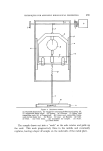
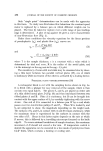
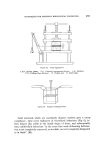
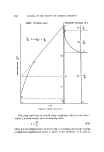
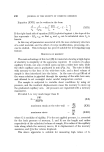
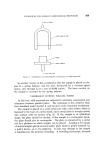
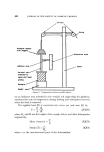
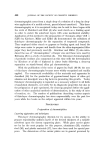
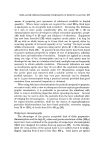
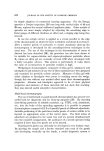
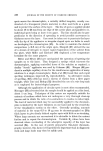
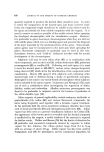
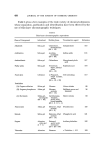
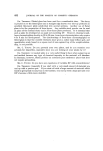
454 JOURNAL OF THE SOCIETY OF COSMETIC CHEMISTS c•, ½sr•ss : •o ) •cow• (stRess o') t Fig•r• 6 Model creep curve. The creep curve has an overall creep compliance J(t)/• at any time t, where J is shear strain, and a is shearing stress. J = •f (XlI) h where [1 is the displacement observed with a travelling microscope having a reciprocal magnification factor f, and h is the thickness of S• and

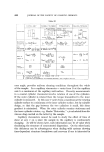
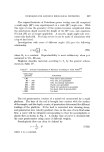
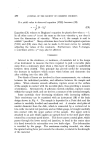
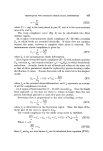
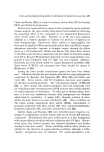
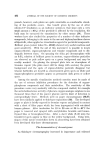
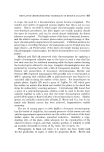
TECHNIQUES FOR ASSESSING RHEOLOGICAL PROPERTIES 455 F *- 2A (Xm) where F (= mg) is the load placed in pan W, and A is the cross-sectional area of S• and S•. The creep compliance curve (Fig. 6) can be sub-divided into three distinct regions. {1) A region of instantaneous elastic compliance (A - B) with a modulus E o, in which bonds are stretched elastically. If shear does not continue beyond this point, recovery is complete when stress is removed. The instantaneous elastic compliance is given by 1 Ja(t) Co -- -- (XIV) E o where Ja is the instantaneous elastic deformation. (b) A region of retarded elastic compliance (B - C) with an elastic modulus E R, viscosity %, and retarda tiontime ,• (---- •/E•), in which bonds break and reform. Actually, bonds do not all break and reform at the same rate so that all three parameters should be replaced by spectra showing a wider distribution of values. Present discussion will be restricted to the simplest model. CR _ 1 _ C(1- e-t/-rR) •- Jb(t) (XV) E R where Jb is the retarded elastic deformation, and C R represents an average of all the compliances involved. (c) A region of Newtonian flow (C - D) with viscosity •ls. Once the bonds have ruptured, i.e the time for them to reform is longer than the test period, individual particles or units flow past one another. Newtonian flow is proportional to the time of loading, so that Cs _ t _ Jo(t) (XVI) where Jo is deformation in the Newtonian region. Thus, the slope of the linear part of the curve is equal to 1[• s. The overall compliance for the whole creep curve is, therefore, J(t) _ Co + CR + CN = Co + C(1- e-%R) +t (XVII) Where t --• 0 J(t) -- C o (XVIII) Since C o and •ls are now known C• can be calculated from equation (XVII).
Purchased for the exclusive use of nofirst nolast (unknown)
From: SCC Media Library & Resource Center (library.scconline.org)