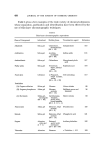
THIN-LAYER CHROMATOGRAPHIC TECHNIQUES IN RESIDUE ANALYSIS 491 (103) (104) (105) (106) (107) (108) (109) (110) (111) (112) (113) (114) (115) (116) (117) (118) (119) (120) (121) (122) (123) De Faubert Maunder, M. J., Egan, H. and Roburn, J..dnalyst 89 157 (1964). Marco, G. J. and Jaworski, E.G. J. Agr. Food Che•n. 12 305 (1964). Wilde, P. F. Lab. Pract. 13 741 (1964). Milleft, M. A., Moore, W. E. and Seaman, J. F. A•al. Chem. 3{I 491 (1964). Fowler, t-I. D. Nature 1{18 1123 (1951). Privett, O. S. and Blank, M. L. J. Lipid Res. 2 37 (1961). Squibb, R. L. Nature 199 1216 (1963}. llaus, R. J. Chromatog. 1{1 311 (1964). Seher, A. Nahrung 4 466 (1960). Purdy, S. J. and Truter, E. V. Chem. Ind. London 506 (1962). Purdy, S. J. and Truter, E. V. Analyst 87 802 (1962). Aurenge, J., Degeorges, M. and Normand, J. Bull. Soc. Chirn. France 1732 (1963). Waldi, D., Schnackerz, I. and Munter, F. J. Chromatog. {1 61 (1961). Fischer, R. and Lautner, H. Arch. Pharm. 294 1 (1961). Seher, A. Fette Seifen. Anstrichmittel {11 345 (1959). Morris, L. J., Holman, R. T. and Fontell, t. J. Lipid Res 2 68 (1961). Wollenweber, P. J. Chromatog. 7 557 (1962). Peereboom, J. W. C. J. Chromatog. 4 323 (1960). Van Dam, M. J. D. J. Chromatog. 4 26 (1960). Pastuska, G. Z. Anal. ½hem. 179 427 0961). Seher, A. Mihrochim. Acta 398 (1961). DISCUSSION DR. •V[. lq. W. ]BROWN: Could you tell me if you have any experience of using thin-layer chromatography to separate sugars that are normally quite difficult to separate [Table I] ? DR. THOMSON: No. The literature, however, has many references to such separation. ]By preparing multi-band plates it should be possible, by varying the polarity of the layers, to separate even very closely related sugars. DR. A. R. ROGERS: YOU have referred to the work of Truter (112) and others, on relating some function of the size of the spot to some function of the weight of material. This seems a counterpart to biological assays. Do you agree that there is no unique answer ? DR. THOMSON: I agree that this relationship ought to be developed for each system. If, from the developed plate, the relationship of the square root of the area and the weight of compound applied to the plate is to be a straight line, then it is essential that the same quantity of the compound should be applied to the plate in the same volume of solvent. With care and practice it is possible to get a straight line relationship down to very small quantities, i.e. 0.5 DR. A. R. ROGERS: Could you tell us of your experience with Kodak plastic plates ? DR. THOUSON: We did not find these plates of any particular use in pesticide residue analysis where the plates were developed in hexane:acetone mixtures. However, other people might find them useful for the separation of other substances using different solvent systems. MR. J. D. Ca•smR•: I have heard that the simplest and cheapest plate is made from reeded or fluted glass. One pours the silica gel slowly over this and then smoothes it off with a glass rod after drying one applies one spot to each flute. Do you have any experience of this ?

492 JOURNAL OF THE SOCIETY OF COSMETIC CHEMISTS DR. THOMSON: Fluted glass has been used for a considerable time. The slurry is poured on to the fluted glass and a straight edge drawn over the top produces an excellent thin-layer plate subdivided into several sections. Another use of fluted glass is for the preparation of loose-layers. Any suitable-sized powder can be used in place of the normal slurry and a loose-layer plate produced. It is essential that such a plate be developed at an angle not exceeding 15 ø. However, whereas bound- layer chromatoplates develop in 30 to 35 min, loose-layer chromatoplates only require 4 to 5 rain for development. The disadvantage of loose-layer chromatography on fluted glass is that the variable thickness layer gives a rather large diffuse spot, and quantitative work, based on a square root of area against log of the weight relation- ship, is not possible. MR. C. YOUNG: Do you prewash your own plates, and do you examine your solvents for impurities, especially since you are looking at your plates by Jr? De. THOMSON: A •ashed plate is a very useful thing to have when using ir as an end method because any type of chemical impurity in the material will interfere. In Germany, however, Merck produce an extremely pure stationary phase that does not require prewashing. MR. C. YOUNG: Do you have any experience of variable RF with concentrations ? DR. THOMSON: Generally if you start with a very small amount of material you end up with a precise spot. If you start off with a large amount of material which tends to get spread out anyway on the baseline, you end up with a large spot and your RF's become a little more doubtful.
Purchased for the exclusive use of nofirst nolast (unknown)
From: SCC Media Library & Resource Center (library.scconline.org)