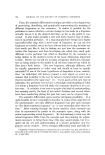
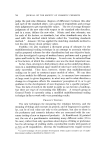
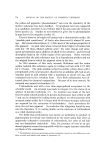
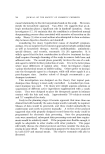
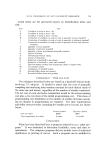
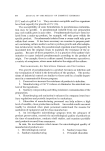
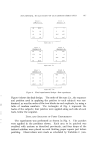
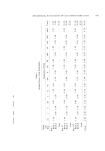
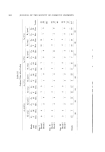
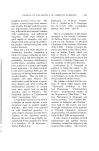
ItAND DEGERMING EVALUATION Table [ Split-Use Washing and Bacterial Sampling Schedule Day Ti•ne Left hand Right hand 773 Monday am Ivory Ivory Noon Ivory (count) Ivory (count) pm Ivory Test soap Tuesday am Ivory Test soap Noon ivory Test soap pm Ivory Test soap Wednesday am Ivory Test soap Noon s Ivory (count) Ivory (count) test soap pm Ivory Test soap Thursday am Ivory Test soap Noon Ivory Test soap pm Ivory Test soap Friday am ivory Test soap Noon Ivory (count) Ivory (count) After count wash on Wednesday, right hand washed with test soap. containing 0.75% hexachlorophene and 0.75% 3,4,4'-trichlorocarbani- lide, a synergistic bacteriostatic system. The second bacteriostatic soap (Soap B) contains equal parts by weight of 3,5-di and 3,4',5-tribro- mosalicylanilides, 4,4'-dichloro-3- (trifiuoromethyl) carbanilide, and 3,4, 4'-trichlorocarbanilide for a total of 2%. RESULTS AND DISCUSSION A total of twenty-four men and women of various occupations were divided into four panels for the experiment. Two methods of analyzing the data were used to determine degerming efficiency of the two medi- cated soap bars: per cent reduction and an analysis of variance. Be- fore analyzing the data by an analysis of variance, logarithms of the bacterial counts were taken. In Table II are presented the results of the analysis. A statistically significant difference was found between the degerming properties of the two bacteriostatic soaps as compared to the nonmedicated soap. For this test to show a statistical difference between medicated and non- medicated soaps, the probability that a difference does not exist should be less than or equal to 0.05. The analysis also showed that there was no significant variation among panelists for all four tests. This indicates that in these panels

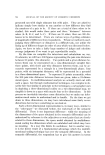
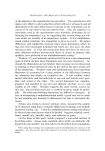
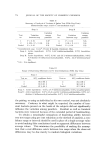
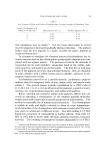
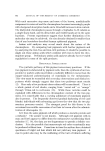
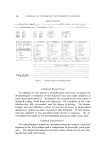
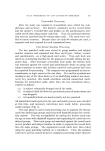
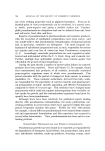
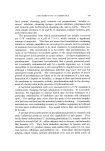
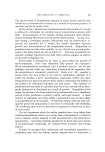
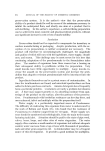
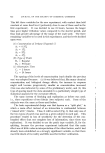
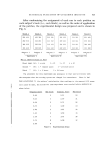
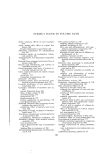
774 JOURNAL OF THE SOCIETY OF COSMETIC CHEMISTS Table II Summary of Analysis of Variance of Quinn Test (Fifth Day Data) (Bacteriostatic soaps A & B rs. non-medicated soap a) Soap A Soap B Variation Variation Test Variation among Test Variation among no. between soap panelists no. between soap panelists 1 P 0.01 N.S. b 3 P 0.01 N.S. 2 0.025 P 0.05 N.S. 4 0.05 P 0.1 N.S. Pooled P 0.01 N.S. Pooled P 0.01 N.S. Nonmedicated soap: Ivory ©, Procter & Gamble, Cincinnati, Ohio. Soap A: Active ingredients: 0.75% 3,4,4•-trichlorocarbanilide, 0.75% hexachloro- phene. Soap B: Active ingredients: 0.67% 3,5-di- and 3,4',5-tribromosalicylanilides, 0.67% 4,4•-dichloro-3-(trifluoromethyl)carbanilide, 0.67% 3,4,4•-trichlorocarbani - lide. N.S.: Not significant. Table III Range of Degerming Efficiencies in Per Cent Reductions (Fifth Day Data) Soap A Soap B Test no. 95% confidence limits Test no. 95% confidence limits 1 88.5-98.5 3 84.5-99.4 2 83.0-91.5 4 86.5-97.5 Pooled 87.4-96.2 Pooled 87.7-98.9 Soap A' Active ingredients: 0.75% 3,4,4•-trichlorocarbanilide, 0.75% hexachlorophene. Soap B: Active ingredients: 0.67% 3,5-di- and 3,4•,5-tribromosalicylanilides, 0.67% 4,4 •- dichloro-3-(trifiuoromethyl)carbanilide, 0.67• 3,4,4•-trichlorocarbanilide. the pairing, or using an individual as his own control, was not absolutely necessary. Contrary to what might be expected, the number of tran- sient bacteria present on the hands of the subjects did not significantly influence the variation among panelists. Resident as well as transient bacteria were removed because of the extended period of handwashing. To obtain a meaningful comparison of degerming ability between two test soaps using per cent reduction as the method of analysis, a con- fidence range or interval should be used in place of a single average value to avoid making false conclusions based on apparent differences between average values. This minimizes the possibility of making the assump- tion that a real difference exists between two soaps when the observed differences may be due merely to random biological variations.
Purchased for the exclusive use of nofirst nolast (unknown)
From: SCC Media Library & Resource Center (library.scconline.org)