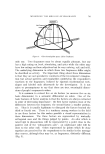
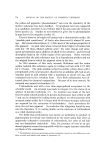
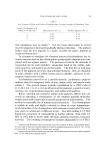
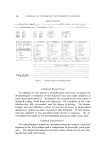
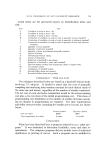
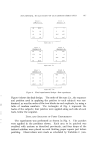
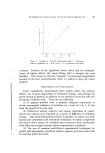
MEASURING THE MEANIN( OF FRAGRANCE I ACTIVITY* J 761 Figure 3. Odor description space (after Paukner) only one. Two fragrances may be about equally pleasant, but one has a high rating on fresh, stimulating, and spicy while the other may have low ratings on these adjectives but be very calming, soft, and mild. The underlying dimension in which these two fragrances differ might be described as activity. The important thing about these dimensions is that they are not speculative contructs of the investigator's imagina- tion but actual patterns and regularities underlying the respondent's reactions to the fragrances, isolated by rigorous mathematical tech- niques and labeled only afterwards by the investigator. It is not naive or presumptuous to say that these are true, meaningful dimen- sions of people's responses to odors. It is common to extract five or six factors (or uncover five or six basic dimensions) in a semantic differential on odors. One of the basic features of factor analysis is that the factors are always extracted in order of decreasing importance: the first factor explains most of the differences between the responses, the second factor a smaller portion, etc. Thus it is usually legitimate to disregard the factors beyond the third or fourth one. There is a tendency among workers in the field to use three factors for this makes possible a visual representation in three dimensions. The three factors are represented by mutually orthogonal axes and the things judged by points. An odor which is rated high in pleasantness will be represented by a point close to the positive end of the "pleasantness axis" an unpleasant odor will lie close to the other end. Odors represented by points which lie close together are perceived by the respondents to be similar in the message they convey, although they may be, as fragrances, distinctly different (Fig. 3).

762 JOURNAL OF THE SOCIETY OF COSMETIC CHEMISTS Thus, the semantic differential technique provides a very elegant way of uncovering, describing, and graphically representing the meaning of different fragrances to the consumer. It makes it possible for the perfumer to assess whether a certain change he has made in a fragrance actually moves it in the desired direction, as far as the public is con- cerned. It also makes possible a new and truly creative type of imita- tion of successful perfumes. If a soap manufacturer brings out a highly successful toilet soap with a novel type of fragrance, we can use this fragrance as a model, not as we have always done by trying to make one that smells just like it, but by finding out just how the consumer de- scribes this fragrance and then developing one which may smell quite different to the perfumer but which is described by the consumer as being similar to the model in terms of the basic dimensions important to him! Better yet, we will try to make a fragrance which the consumer sees as being similar to the model in all relevant respects but which he likes just a little better. This new fragrance, although different, will be equally appropriate to toilet soap and should at least be equally successful* if one of the basic hypotheses of linguistics is true, namely, that "an individual will behave toward a new object or event in a manner that is similar to the way he behaves toward objects and events that he encodes in the same way" (7). To be good at this new type of imitation, the perfumer has to have a thorough understanding of what it is about a fragrance that will make the consumer describe it in a cer- tain way. It certainly is not easy to acquire this kind of understanding but running exactly the kind of test which Paukner and several others have been conducting during the past few years can be of great help. The semantic differential opens another intriguing possibility. It is quite feasible to have respondents describe, in terms of the adjectives of the questionnaire, not only different fragrances but also such concepts as "the ideal erogenous fragrance" or "a very masculine after-shave lo- tion." After running through the factor analysis, these concepts can then be represented by points in the semantic space, along with the points representing actual fragrances. By determining in what way the actual fragrances differ from the concepts and then making the adjust- ments necessary to bring them close (this may sound simple, but it re- quires all the art and understanding of a master perfumer) new fra- grances can be created. If the semantic differential truly and fully de- * Naturally, if this new fragrance is incorporated in a new toilet soap, this soap will be as successful as its model only if everything else about it, soap quality, name, price, packaging, etc., is also right.
Purchased for the exclusive use of nofirst nolast (unknown)
From: SCC Media Library & Resource Center (library.scconline.org)