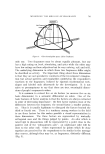
MEASURING THE MEANING OF FRAGRANCE 763 scribed the respondents' feelings, if the respondents were representative of the population for whom the new fragrance is intended, and if it is true that people act similarly toward things they describe similarly, the new fragrance thus developed should be highly successful. Let us now take another close look at the semantic differential. What are the basic dimensions it uncovers ? Are they always the same ? In principle, the dimensions emerging will depend both on the odors or other stimuli tested and on the adjectives used in the questionnaire. If the range of adjectives is sufficiently broad and diverse so that the re- spondent can clearly express through them any and all feelings he has about odors, then the adjectives should not place any limitation on the factors emerging. But what odors (or other things) are tested does make a difference. Paukner found that his first three dimensions were characterized, respectively, by the adjectives beautiful/harmonious, spicy/alert/strong, andfresh/hard/aggressive. He labeled the first dimen- sion evaluation, the second activity and the third intensity.* Rande- brock, in a similar study, found that his first dimension was characterized by the contrasting word pairs elated-depressed, and uplifting-depressing the second one by the word pairs, ferocious-gentle and stern-mild and the third dimension by bracing-insipid and full-empty (8). These di- mensions are similar to Paukner's, but they are not identical. In some of our own studies on foods and flavors we found wholesome-risky and everyday-party emerging as important dimensions. ODOR CLASSIFICATION AND MULTIDIMENSIONAL SCALING Recently there has been a resurgence of interest in the old question: Are there any basic odor types in terms of which all odors can be de- scribed (9)? A great deal is known about the four basic tastes, about the primary colors, and about the physical foundation of acoustics, but odor has always defied meaningful, objective, verifiable classification. Couldn't the new techniques of uncovering the basic dimensions of fragrance lead us to a recognition of the "primary odors," if such exist ? Most of the investigators who have worked in this area have not used the semantic differential to construct their "odor space" but have used a technique which, starting from different premises, leads to a similar representation of odors as points in a space. This is the technique of multidimensional scaling (10). In this technique the respondents are * These three dimensions, with the third one usually labeled potency, are also the main ones which Osgood obtained when examin. ing all kinds of concepts .and things other than odors, using t he semantic differential,

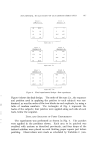
764 JOURNAL OF THE SOCIETY OF COSMETIC CHEMISTS presented not with single odorants but with pairs. They are asked to indicate simply how similar to one another or how different they find the members of a pair to be. If there are a total of three odors to be studied, this would make three pairs and three "distances" between odors (A-B, B-C, and A-C). If there are 25 odors, there are 300 dis- tances to be determined. There are various ways of getting estimates of magnitude of difference from respondents. Whatever method is used, judging these differences or distances is a difficult task, not unlike the lining up of different shapes in order of area which was discussed before. Again, we have to take a fairly large number of judges and calculate average judgments if we want to get reproducible results. By the time we complete the interviews and calculations on, say, 25 odorants, we will have 300 figures representing the pair-wise distances between 25 points (the odorants). Two points and a given distance be- tween them can be represented on a (one-dimensional) straight line three points, with three pair-wise distances between them, can be ac- curatdy represented by a triangle in a (two-dimensional) plane four points, with six interpoint distances, will be represented by a pyramid in a three-dimensional space. To represent 25 points accuratdy, when the 300 pair-wise distances between them are given, takes a 24-dimen- sional space. In multidimensional analysis we actually start out with such a space, but through mathematical techniques, too complex to de- scribe here but similar in principle to the techniques a cartographer uses in depicting a three-dimensional reality on a two-dimensional map, we simplify it down to a space with maybe four or five dimensions. In this process we inevitably introduce some distortion but we make our infor- mation much easier to understand and to handle. By the t/me we get down to three dimensions, we may have introduced some fairly severe distortions but we have something we can look at. Such a three-dimensional representation is, in many ways, similar to the "odor-space" we discussed before, the end-result of the semantic differential. There is one important difference: while the meaning of the dimensions of the space obtained in the semantic differential can be understood by reference to the adjectives or word pairs that are closely related to these dimensions, the space model obtained by multidimen- sional scaling has dimensions which are unlabded and which may have no meaning. In a way this limits its usefulness but in another way, it is the direct result of a fundamental advantage which the multidi- mensional scaling technique has over the semantic differential. In the semantic differential, the respondent has to give his answers in terms
Purchased for the exclusive use of nofirst nolast (unknown)
From: SCC Media Library & Resource Center (library.scconline.org)