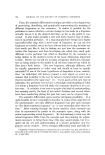
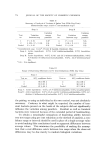
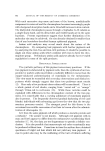
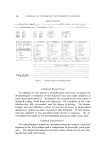
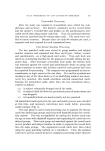
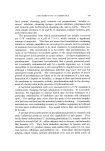
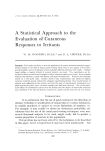
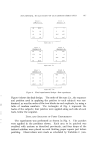
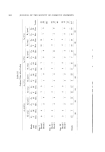
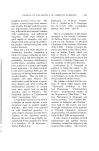
790 JOURNAL OF THE SOCIETY OF COSMETIC CHEMISTS DANDRUFF QUESTIONNAIRE How would you rate the test product which you used the past 2 months* (Check only one). Sub .... No. 1-3 Group No. / 4-5 Sex I--]Male [•rFemale Age One of the best I've tried Good, but not one of the best • 2 Fair 3 Poor [] 4 6 During the month before you started this test, what on•e product did you use most for treatrag dandruff or washing your hair: 7-18 How would you rate the test product you used the past 2 months with the one listed Immediately above . (Check proper boxes) Test Product Test Product Test Product MORE EFFECTIVE AS EFFECTIVE LESS EFFECTIVE Comparison of DANDRUFF results A. Red ...... i ........ f dandruff [• [] •]19 B. Length of time dandruff was reduced [] • [] 20 Hair MORE MANAGEABLE [] J• [•1 Hair FEELS CLEANER []• [] g22 1 2 Please write down everything you can think of thor you LIKED about this test product: CODE -•--"• 23-24 106, I 25-26 27-28 29- 30 Please write down everything you can think of that you DISLIKED about this test product: CODE i• 31-32 33-34 35-36 37-38 Using the =Scale For Evaluat,ons" enter the number in boxes 39 and 40 which best describes your experience with hair loss durmg the last week of the study. HAIR LOSS from COMBING SHAMPOOING i I 39 40 SCALE FOR EVALUATIONS 0 - Absent 1 - Mild 2 - Moderate 3 - Moderate to Severe 4 - Severe Figure $. Patient questionnaire transmittal form

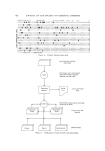
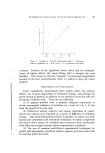
DATA PROCESSING OF ANTI-DANDRUFF RESEARCH 791 Transmittal Processing After the study was completed, transmittals were edited for com- pleteness and accuracy. The doctor's comments on the record forms and the subject's recorded likes and dislikes on the questionnaires were coded at this time using master code lists. Next, the pertinent informa- tion was key punched into 80-column data cards. The cards were veri- fied to insure accuracy. Because there are only 80 columns per card, a separate card was required for each transmittal form. Unit Record Machine Processing The key punched cards were sorted to group number and subject number sequence and separated into three card types--history, record, and questionnaire--on a high-speed card sorter. Then each deck was listed on a tabulating machine for the purpose of visually editing the key punch data. After necessary corrections were made, the history deck was matched against the record and questionnaire decks on group and subject numbers to insure that all three cards for each patient had been key punched for processing. The computer was programmed to note in- consistencies or logic errors in the raw data. If a card for a patient was missing in any of the three decks or if an identifying number was incor- rectly key punched, this would constitute selected unmatched cards. Reasons for unmatched cards, other than the two mentioned above, could be as follows: (a) A subject voluntarily dropped out of the study. (b) A subject failed to follow the prescribed protocol instructions and was dropped. (c) A transmittal form was inadvertently not key punched. All unmatched cards ejected in the sort and match process were checked at this time, and necessary corrections were made before processing could continue (Fig. 6). The next phase in unit record processing was to segment the history cards into desired age groups and years with dandruff groups for correla- tion reports. This was accomplished by sorting the history cards into the age or years with dandruff sequence and separating the cards into the desired groups. Then each group was matched against the record cards on test product and subject number in order to separate the record deck into the same groups. The segmented record cards were then coded using the gang punching method on a reproducer. Thus, the assigned codes were used as control factors in computer processing rather than the
Purchased for the exclusive use of nofirst nolast (unknown)
From: SCC Media Library & Resource Center (library.scconline.org)