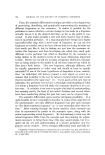
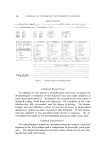
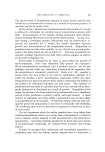
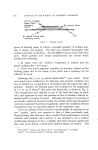
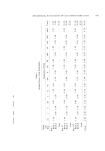
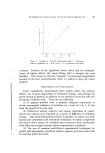
MEASURING THE MEANING OF FRAGRANCE 759 a highly structured questionnaire it becomes easy to arrive at a group judgment simply by adding individual votes. The technique of providing the respondent with words rather than letting him choose his own carries with it the danger of losing infor- mation a respondent will not be able to express the meaning an odor has for him if you don't provide him with the words with which to ex- press it. It is, therefore, important to use a well-chosen list of words and to make it long enough to include all aspects of odors that might be relevant. Paukner worked with a list of 66 adjectives. Actually, an extensive list may make the respondent more articulate than a free "open end" questionnaire by reminding him of ways to describe an odor which are meaningful to him but which he would not have thought of had he been left to his own devices however, we have to admit that there is a danger of "leading the witness" in this procedure. There is yet another advantage inherent in long lists: if they contain words that are either similar or nearly opposite in meaning, the results can be checked for consistency. An odor for which the word strong is rated as highly appropriate should probably have low ratings for delicate and mild. If it doesn't, it may be worth checking whether the respondents have understood the instructions and whether no mistakes were made in the tabulating or processing of the data. Often, where a single piece of information is not meaningful or statistically significant, a pattern of responses such as may be obtained in a longer questionnaire can convey valuable information. Naturally, there are practical limits to the length of a list of words: the longer it is, the more time-consuming and costly the interview and subsequent data processing and interpretation become. After having used his questionnaire in several large-scale tests the experimenter learns which adjectives are the most important and relevant for his particular kind of problems and which ones he can omit without losing much information. Using his lengthy questionnaire, asking 287 respondents to describe six odors and calculating the averages of their responses, what did Paukner achieve? He obtained profiles of odorants in terms of adjectives which give the perfumer, for the first time, a reliable, direct indication how these odorants strike his public, what kind of meaning they convey to nonperfumers (Fig. 2). This is certainly important, but it is only a first step. A very natural next step is to apply the same technique of questioning to complete perfume com- pounds rather than single ingredients. Thus Paukner (6) took a simple lavender composition and proceeded to add increasing amounts of an ambermuskcivet complex to it. According to the perfumer (2) this

76O JOURNAL OF THE SOCIETY OF COSMETIC CHEMISTS exciting st rong passive friendly loud empty beautiful stern deOressing dull De•lree of Appropriateness 1 2 3 4 5 6 soothing weak active aggressive soft full ugly mild exalting biting Figure 2. Partial profile of amber (after Paukner) should make the composition increasingly sexy but does the public agree? Paukner tested it and found it to be so. In these tests, he used a mathematical extension of the profile generation technique: He applied a factor analysis to his scores and thus obtained a semantic differential (1). We are here getting into territory that may seem obscure to the nonpsychologist and the nonstatistician the underlying ideas, however, are fairly simple. If we take a number of odors, each of which is described in terms of the appropriateness of a series of adjectives, we can, by carefully looking at the data, discover certain patterns. Odors which are described as fresh, warm, or cheerful, are likely also to have high ratings on the adjectives pleasing and harmonious and to have low ratings on poor or artificial. This is because the words fresh, warm, and cheerful have overtones of goodness and pleasantness which are also inherent in pleasing and harmonious but not in poor and arti•cial. This underlying notion of pleasantness, which will tend to make the ratings on adjectives such as fresh, warm, cheerful, and harmonious move together as we pass from one fragrance to another, is, in a mathematical sense, a factor which can account for a certain proportion of the dif- ference between different odors. In a psychological sense, it is one of the basic dimensions in terms of which odors are perceived. Certainly, pleasantness is usually a very important factor, but it is by no means the
Purchased for the exclusive use of nofirst nolast (unknown)
From: SCC Media Library & Resource Center (library.scconline.org)