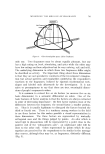
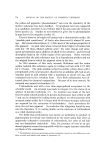
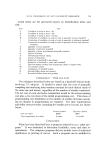
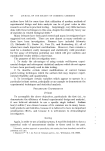
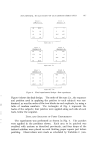
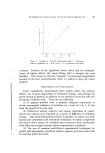
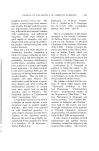
STATISTICAL EVALUATION OF CUTANEOUS IRRITANTS 811 It was believed, however, that the degree of irritation could be judged visually much more precisely than has previously been supposed, and the scale shown in Fig. 1 was therefore adopted. In using this scale, the observer was required to estimate the degree of irritation on the treated site compared to untreated surrounding F{oeure I. Irritation scoring scale skin. During the reading of any site, other treated sites were covered with tissue to eliminate direct comparisons. The estimates were always made to the nearest 0.25 unit on the scale of Fig. 1. (It was shown later that this degree of precision was reasonable.) In planning preliminary work in order to identify possible real variables affecting irritation with sodium lauryl sulfate, the following factors were considered' Size of patch Type of covering (occlusion) Nature of patch Quantity of test solution Concentration of irritant Patch contact time Observation time (elapsed time after removal of patch) Tightness of patch Nature of subjects' skin Activity of subjects It was intended that many of the potential variables be held con- stant so that the exposition of the statistical procedure would not be confused because of undue complexity. It is to be understood that in any real system under investigation it may be practical and frequently necessary to test more sources of variation than the number included in this case. The experimental designs then used would simply be exten- sions or modifications of those shown here.* In the present case, some preliminary work was done in order to try to select a small number of important factors from the above list. This work is treated briefly below. Development of Type of Patch Some initial work was done with oval-shaped open patches, such as are used often in routine patch testing. These were applied over • in. * There are many modifications of factorial designs, as well as certain nonfactorial ar- rangements a vailable which do not require extremely large experiments when many variables are to be evaluated.

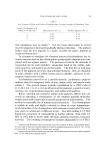
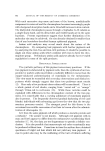
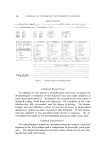
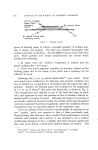
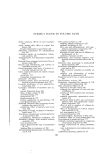
812 JOURNAL OF THE SOCIETY OF COSMETIC CHEMISTS d. 8 J.l• in. square Plastic Patch '• with gauze • ••qulr I Saran square • I af / 1/1//////t/tit/lift7///////////////////// t• -•in. square blotting paper Skin containing irritant Figure 2. "Regular" patch pieces of blotting paper to which a constant quantity of irritant solu- tion (4 drops) was applied. The skin was swabbed thoroughly with acetone just prior to patching. Several different areas of the body were used. These patches were found unsatisfactory for reasons which included the following: 1. In many cases the solution evaporated or soaked into the gauze backing after a few hours. 2. There was much apparent variation in pressure exerted on the blotting paper due to the shape of the patch and a tendency for the adhesive to creep. Following this, •/5 in. sq. plastic Band-Aids ©'* were tested. These were much more satisfactory for adhesion and pressure variation, but loss of solution by evaporation or absorption into the patch was still a problem. Finally, the blotting paper was occluded by the application of a a/g in. sq. of Saran©t film under the Band-Aid, as shown in Fig. 2. This arrangement was adopted as one of the final two types of patch used, and appeared to solve the problem of loss of solution blotters re- mained moist even after 24 hours. Although this degree of occlusion is not usually employed in patch testing, the results of this and subsequent work have indicated that this arrangement, under the conditions of these experiments, may be generally superior to the customary type. There was strong evidence that the reproducibility of reactions to the new "regular" patch was superior to that of those previously used. Hypothesizing that this may have resulted from maintenance of more constant and intimate skin contact, it was decided to try a further modification designed to have a slightly increased pressure against the skin, and, it was hoped, a much more uniform degree of contact. This * Band-Aids©--Johnson and Johnson & Co., New Brunswick, N.J. 08903. t S aran©--The Dow Chemical Co., Midland, Mich. 84641.
Purchased for the exclusive use of nofirst nolast (unknown)
From: SCC Media Library & Resource Center (library.scconline.org)