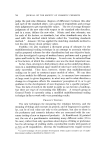
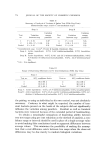
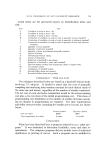
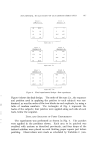
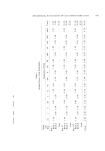
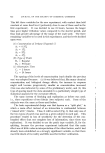
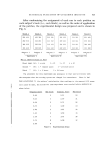
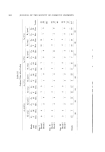
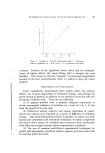
DATA PROCESSING OF ANTI-DANDRUFF RESEARCH 795 Listed below are the generated reports by identification letter and title. •em A B C H I J D E F G K O P L M N R S Title Condition of scalp at start dry Condition of scalp at start--oily Condition of scalp at start--normal Correlation of condition of scalp at start to quantity of loose dandruff Correlation of condition of scalp at start to quantity of adherent dandruff Correlation of condition of scalp at start to quantity of loose and adherent combined Quantity of loose dandruff Quantity of adherent dandruff Quantity of loose and adherent dandruff combiued Degree of itching Overall improvement rating Degree of dermatitis Reduction of dandruff vs age groups Reduction of dandruff vs years with dandruff Hair loss during combing and shampooing (Start vs eighth week) Test product rating Comparison of dandruff results Recorded likes about test product Recorded dislikes about test product COMPARISON' TIME AND COST The estimates described below are based on a dandruff clinical study involving 717 subjects. It should be noted that the cost of manually compiling and analyzing data remains constant for each clinical study of the same size and nature, regardless of the number of studies conducted. The net cost of each electronic compilation would be the actual running cost plus a pro-rata share of the initial programming cost. This share of programming cost diminishes as the number of studies increases assum- ing no changes iu programming are required. The time requirements and dollar costs per study (assuming five studies are to be run) are shown below: Manual method Electronic method Cost per study $2500 $800 Time requirement per study 6 weeks 1.8 weeks CONCLUSION What has been described here is properly referred to as a "pilot pro- gram." It was instituted to determine feasibility, costs, and time re- quirements. The computer program did not include tests of statistical significance or plotting of curves. Such a program can be modified to

796 JOURNAL OF THE SOCIETY OF COSMETIC CHEMISTS include all the statistical treatments previously done manually. It has been shown that computer processing can significantly reduce the amount of time required to complete analysis of results in a large clinical trial, eliminate human mechanical errors, and at the same time save a considerable amount of money. When a program is used in more than one trial, the savings in both time and dollars become even more dra- matic. (Received May 22, 1967) (1) (2) (3) (4) (5) (6) (7) (8) (9) (lO) (ll) (12) (13) (14) (15) (16) (17) (18) (19) (20) REFERENCES Malassez, R., from Van Abbe, N. J., The investigation of dandruff, J. Soc. Cosmetic Chemists, 15,609-30 (1964). Savill, A., The Hair and Scalp, Third Ed., Williams & Wilkins, Baltimore, Md., 1944, pp. 153-68. Harry, R. G., The Principles and Practice of Modern Cosmetics, Vol. I--Modern Cos- meticology, Chemical Publishing Company, New York, N.Y., 1962, pp. 332-9. MacKee, G. M., and Lewis, G. M., Dandruff and seborrhea. I. Flora of "normal" and diseased scalps, J. Invest. Dermatol., 1, 131-9 (1938). Wright, C. S., The seborrheic state, its etiology and control, Med. World, 59, 431-3 (1941). Kelly, D. E., and Arlook, T. D., Seborrheic dermatitis, J. Indiana State Med. Soc., 43, 1088-91 (1950). Dowling, G. B., Aetiology of seborrhoeic dermatitis, Brit. J. Dermatol., 51, 1-7 (1939). Mitchell-Heggs, G. B., Seborrhoeic dermatitis and ache vulgaris, Brit. Med. J., 2, 1079- 82 (1951). VanderWyk, R. W., and Roia, F. C., The relationship between dandruff and the micro- bial flora of the human scalp, J. Soc. Cosmetic Chemists, 15,761-8 (1964). Ball, F. I., A new treatment for seborrhoeic dermatitis, Arch. Dermatol., 71,696 (1955). Reddish, G. F., The etiology of infectious dandruff, Y. Soc. Cosmetic Chemists, 3, 90 (1952). Klauder, J. V., Modern concept and treatment of dandruff and seborrheic eruptions, Ibid., 7,443-9 (1956). Lubowe, I. I., Anti-seborrheic agents, Drug and Cosmetic Ind., 81,602-76 (1957). Spoor, H. J., Microbiological and clinical study of anti-dandruff agents, Proc. Sci. Sect. Toilet Goods Assoc., No. 23, 27-31 (May 1955). Wallace, H. J., Diseases of the hair and scalp, The Practitioner, 188, 594-608 (1962). Van Abbe, N.J., The investigation of dandruff, 2. Soc. Cosmetic Chemists, 15,609-30 (1964). Robinson, R. C. V., and Roberts, D., A new medicated shampoo for seborrheic scalp conditions, Maryland Med. J., 12,223-5 (1963). Spoor, H. J., Clinical evaluation of antidandruff formulations, J. Soc. Cosmetic Chemists, 14, 135-45 (1963). Howard, K. L., The uses of enzymes in cosmetics, Ibid., 13, 59-63 (1962). Cayle, T., The potential of enzymes for topical application, Ibid., 14,249-59 (1963).
Purchased for the exclusive use of nofirst nolast (unknown)
From: SCC Media Library & Resource Center (library.scconline.org)