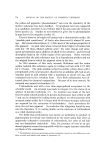
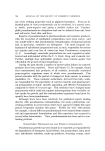
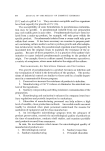
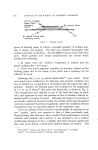
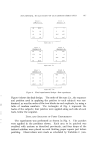
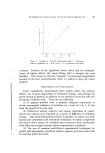
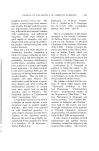
828 JOURNAL OF THE SOCIETY OF COSMETIC CHEMISTS '• 3o Figure 8. Variable B X C. • 6 2 pr,ss•re" Po•½h i i i 4 8 112 t6 210 •14 Elapsed Time After Removal of Palche*, Hours Plot of observation time X patch = type interaction. fieant at 0.05 level) (Signi- The more specific and less important conclusions to be drawn from this work are connected with the specific variables used. Discounting the first experiment except for the contact time variable, because of the relatively low significance levels obtained, and remembering that the analyses were of the kind known to statisticians as Type I (i.e., more or less limited to the particular levels of the variables and particular populations used), the following conclusions were drawn: (1) The increase of irritation with increasing concentration of sodium lauryl sulfate (within the range of concentrations tested) appears to be a logarithmic function, with the rate of increase of irritation decreas- ing as concentration increases. (2) The changes in observable irritation which occur after the patches are removed have not been emphasized in the literature. This work suggests that it is important to give the skin adequate time to develop a full irritation manifestation and to take this factor into account, especially in view of its interaction with the type of patch used. (3) The use of the "pressure" patch, as explained above, was meant not as a device to apply pressure per se, but as an attempt to determine whether normal minor variations in pressure under a patch affect the results, so that if so, means for controlling it and thus mini- mizing variation could be arranged. As this work shows, a relatively small increase in pressure was apparently very important, especially at certain observation times. This suggests that more study and experi-

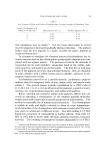
STATISTICAL EVALUATION OF CUTANEOUS iRRITANTS 829 mentation in the design of patches and the techniques used in applying them is desirable. (4) It has frequently been felt that lack of uniformity in patch test responses is the result of a "pressure effect." This work has demonstrated that one of the greatest sources of variation is subject-to- subject variation, which is easily isolated by proper experimental designs, which in turn has the effect of sensitizing the experiment so that a given variable may be tested with a much smaller group of subjects than otherwise. Of course the use of small groups presupposes that they are a fair sample of the population to which the results are to be extrapolated. (Received February 14, 1967) (1) (2) (3) (4) (5) (6) (7) (8) (9) (10) (n) (i2) (13) (14) (15) (16) REFERENCES Schneiderman, M. A., Is it really bad? A proposal for the toxicity-testing of drugs, J. Soc. Cosmetic Chemists, 14,227-232 (1963). Schwartz, L., Dermatitis from new synthetic resin fabric finishes, .1. Invest. Dermatol., 4, 459-470 (1941). Shelanski, H. A., and Shelanski, M. V., A new technique for human patch tests, Proc. Sci. Sect. Toilet Goods Assoc., 19, 46-49 (1953). Draize, J., Procedures for the appraisal of chemicals in foods, drugs and cosmetics VIII Dermal Toxicity, Food Cosmetic Law J., 10, 722-732 (1955). Voss, J., Skin sensitization by mercaptans of low molecular weight, .L Invest. Dermatol., 31,273-279 (1958). Rostenberg, A., Cutaneous reactions from cosmetics, J. Soc. Cosmetic Chemists, 11,170- 178 (1960). Davies, O. W. (Editor), Design and Analysis of Industrial Experiments, 2nd ed., Hafner Publishing Co., Inc., New York, N.Y., 1962. Cochran, W. G., and Cox, G. M., Experimental Designs, 2nd ed., John Wiley & Sons, Inc., New York, N.Y., 1962. Goldstein, A., Biostatistics, The MacMillan Co., New York, N.Y., 1964. Snedeeor, G. W., Statistical Methods Applied to Experiments in Agriculture and Biology, 5th ed., The Iowa State University Press, Ames, Ia., 1962. Fisher, R. A., The Design of Experiments, 7th ed., Hafner Publishing Co., New York, N.Y., 1960. Bennett, C. A., and Franklin, N. L., Statistical Analysis in Chemistry and the Chemical Industry, John Wiley & Sons, Inc., New York, N.Y., 1963. Fisher, R. A., and Yates, F., Statistical Tables for Biological, Agricultural and Medical Research, 6th ed., Hafner Publishing Co., Inc., New York, N.Y., 1963. Cox, D. R., Planning of Experiments, John Wiley & Sons, Inc., New York, N.Y., 1958. Shefie, H., The Analysis of Variance, John Wiley & Sons, Inc., New York, N.Y., 1959. Kligman, A. M., and Wooding, W. M., A Method for the Measurement and Evaluation of Irritants on Human Skin, J. Invest. Dermatol. (publication expected in 1967).
Purchased for the exclusive use of nofirst nolast (unknown)
From: SCC Media Library & Resource Center (library.scconline.org)