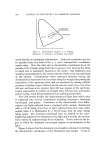
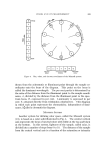
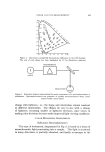
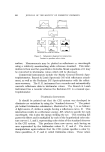
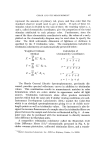
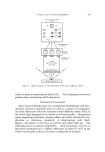
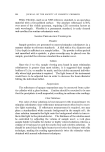
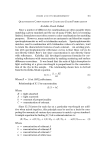
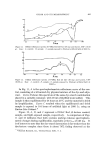
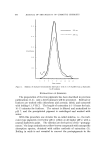
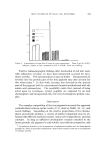
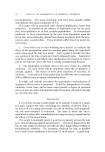
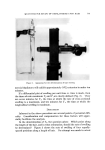
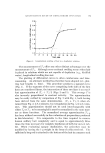
COLOR AND ITS MEASUREMENT (359 Figure 9. COLOR-MEASUREMENT CIRCUIT .¸. ¸ ¸ a -b L• L _ TRISTIMU LUS FILTEI•S CLEAR METHACRYLATE LITE PIPE Block diagram of the Hunterlab D-25 Color Difference Meter values to make a nonmetameric match (21). The techniques involved to perform these calculations will be discussed. REFERENCE STANDARDS Since most tristimulus data are a comparison of luminosity and chro- maticity, reference standards must be used as a means of comparison. An ideal reflectance reference standard would diffusely reflect 100% of the visible light impinged on its surface at all wavelengths. Magnesium oxide, magnesium carbonate, barium sulfate, and white vitrolite have ap- plication as reflectance standards. A disadvantage with MgO, MgCOa, and BaSO4 is that they are brittle and yellow with age. The yellowing process is slowest with BaSO4. Their advantage, however, is that these standards have a diffuse reflectance of about 97-99% in the visible wavelengths, makinx reflectance reading almost absolute.

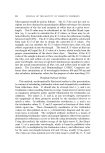
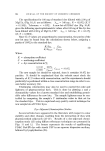
660 JOURNAL OF THE SOCIETY OF COSMETIC CHEMISTS White Vitrolite, used as an NBS reference standard, is an opal glass material with a fire-polished surface. The absolute reflectance is 90% over most of the visible spectrum, requiring CIE correction factors at each wavelength. Vitrolite is a permanent standard, is easily cleaned and excellent for routine colorimetric work. SAMPLE PREPARATION TECHNIQUES Powders Sample powders are presented to most tristimulus colorimeters in a manner similar to reference standards. A dish with a 4 in. diameter and •/•-in. depth is sufficient as a sample holder. The powder is often packed and smoothed with a spatula a glass coverslip may be placed over the sample, provided the reference standard has a similar cover. Tablets Since the 2- to 4-in. sample viewing area found in most tristimulus colorimeters is greater than most tablets, it is suggested that sample holders of • in. or smaller be made, and the tablets measured individu- ally where high precision is required. The light beam of the instrument would have to be adjusted here in order to decrease the beam diameter hitting the individual tablet. Suspensions The reflectance of opaque suspensions may be measured from a plas- tic cylinder with a glass bottom. Caution should be exercised to be sure that the precipitate is well suspended, resulting in uniform color readings. Clear Solutions The color of clear solutions is best measured with transmittance tri- stimulus colorimetry since reflectance measurements often lead to exces- sive light scattering. If reflectance measurement is required, one may place a standardized white ceramic background in the sample cell the clear solution transmits the light onto the background which in turn re- flects this light to the photodetector. The thickness of the solution must be controlled by adjusting the volume of sample used a 5-ml glass sample holder is feasible for darker or highly colored solutions whereas a volume of 10 ml may be used for nearly clear and colorless solutions. It should be noted that the light beams travel twice the distance with this technique, making the reading approximately twice the stimulus values obtained with normal reflectance techniques.
Purchased for the exclusive use of nofirst nolast (unknown)
From: SCC Media Library & Resource Center (library.scconline.org)