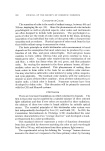
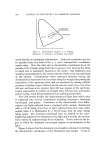
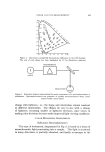
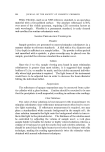
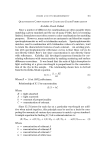
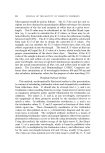
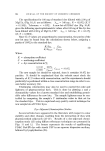
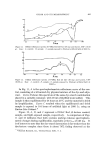
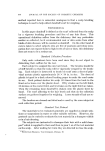
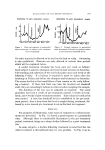
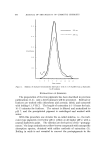
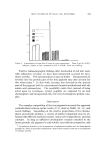
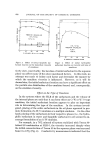
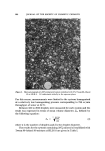
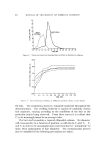
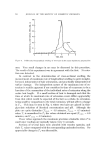
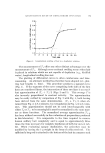
COLOR AND ITS MEASUREMENT 005 lOO A A 2•50 • I • 300 350 4.00 5JO 600 Figure 11. Diffuse reflectance spectra of FD&C Red •3 Dye (30 mg) and starch, USP (10.00 g). Key: A, control B, sample C, sample exposed to 184-hour artificiallight at 2000 f.c. lOO 2hO 2[0 300 3150 4•)0 5•0 6•0 9Jo Figure 12. Diffuse reflectance spectra of FD&C Red #3 Dye (30 mg) and lactose, USP (10.00 g). Key: A, control B, sample C, sample exposed to 184-hour artificial light at 2000 f.c. In Fig. 11, ,4 is the spectrophotometric reflectance curve of the con- trol, consisting of a triturated dry physical mixture of the dye and adju- rant. Curve B shows this spectrum of the same dye-starch combination placed in a suitable container, with 20 ml of distilled water added. This sample is then equilibrated for 24 hours at 30 øC and the material is dried by lyophilization. Curve C resulted when the equilibrated and dried sample is exposed to 184 hours of artificial light at 2000 f.c. using an Envira-Lite Cabinet.* Figure 12, ,4, B, and C represent a FD&C Red #3-lactose control, sample, and light-exposed sample, respectively. A comparison of Figs. 11 and 12 indicates that both systems undergo intense spectrophoto- metric changes during equilibration, especially at the Xm•x of 540 m•. It is of interest to note that the dye-starch interaction is far weaker than the dye-lactose complex since there is about 78% fading observed at the * Thermal Research, Inc., Thermal Road, Iselin, N.J.

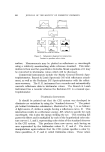
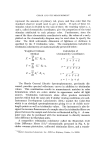
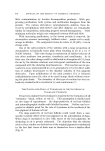
666 JOURNAL OF THE SOCIETY OF COSMETIC CHEMISTS X .... in the starch sample as compared to about 4% fading in the lactose sample (25). These studies and others previously conducted on drug-adjuvant interactions (28) point out the need for dye incompatibility tests in con- junction with other considerations in the formulation of pharmaceuti- cals. CONCLUSION The fundamental measurement prindples indicate that the use of instruments for the control of color will continue to be of great benefit in the cosmetic and pharmaceutical industry. Although future problems will not be totally solved with the aid of instrumentation, the amount of information gained from these techniques more than justifies the use of these methods for the control of color. (Received December 18, 1967) 1) 2) 3) 4) 5) (6) (7) (8) (9) (10) (11) (12) (13) (14) (15) REFERENCES Lach, J. L., and Bornstein, M., Diffuse reflectance studies of solid-solid interactions I, J. Pharm. Sci., 54, 1730 (1965). Swartz, C. J., and Cooper, J., Colorants for pharmaceuticals, Ibid., 51, 89 (1962). Lachman, L., Swartz, C. J., Urbanyi, T., and Cooper, J., Color stability of tablet formu- lations II, Ibid., 49, 165 (1960). Lachman, L., Weinstein, S., Swartz, C. J., Urbanyi, T., and Cooper, J., Color stability of tablet formulations III, Ibid., 50, 141 (1961). Lachman, L., Urbanyi, T., Weinstein, S., Cooper, J., and Swartz, C. J., Color stability of tablet formulations V, Ibid., 51,321 (1962). Goodhart, F. W., Kelly, M. A., and Lieberman, H. A., Characterization of tablet colors obtainable from some certified dyes, Ibid., 54, 1799 (1965). Everhard, M. E., Dickcius, D. A., and Goodhart, F. W., Spectrophotometric reflectance method for matching the color of solid dosage forms, Ibid., 53, 173 (1964). Raft, A.M., Measurement of a color gamut obtained from FD & C colorants, Ibid., 5/i, 380 (1964). Raft, A. M., Tristimulus color measurements in fading studies and other color changes of pharmaceutical dosage forms, J. Soc. Cosmetic Chemists, 18,367 (1967). Harris, C., Jr., Color Instrumentation Seminar, Instrument Development Laboratories, Attleboro, Mass., 1966. Ives, H. E., The transformation of color mixture equations from one system to another iI, J. Franklin Inst., 195, 23 (1923). Guild, J., The colorimetric properties of the spectrum, Phil. Trans. Royal Soc., London, A230, 149 (1931). Nickcrson, D., History of the Munscll color system and its scientific application, J. Opt. Soc. Am., 30, 575 (1940). Wright, W. D., The Measurement of Colour, 3rd Ed., D. Van Nostrand Co., Inc., Prince- ton, N.J., 1964. Committee on Colorimctry, The Science of Color, Optical Society of America, Washing- ton, D. C., 1963.
Purchased for the exclusive use of nofirst nolast (unknown)
From: SCC Media Library & Resource Center (library.scconline.org)