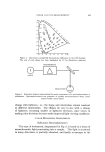
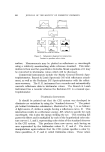
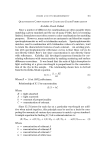
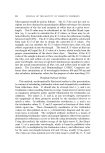
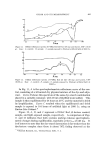
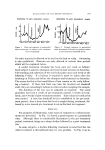
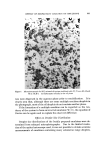
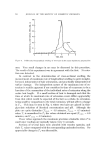
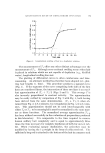
090 JOURNAL OF THE SOCIETY OF COSMETIC CHEMISTS where: Rate 1 = coalescence rate of an O/W emulsion Rate 2 = coalescence rate of a W/O emulsion From thermodynamic considerations, Davies further suggested that the ratio of coalescence rates could be related to the HLB value of the surfaetant and also to the partition coefficient of the surfaetant by the fol- lowing equation: CiRate 2 (c,,'• ø'7•ø C2 Rate 1 - \•/ (1) where: C• = collision factor for Rate 1 C2 = collision factor for Rate 2 c• = surfactant concentration in water Co = surfactant concentration in oil 0 = fraction of interface covered This equation qualitatively agrees with Bancroft's rule that the phase in which the emulsifying agent is more soluble will be the continuous phase (11). If Co and c• can be considered as the initial surfactant concentrations in each phase, it can be shown that the above equation also qualitatively explains the results of the present work. For example, the data presented in Fig. 5 indicate that when the c• is small (or Co is large) the system will form a W/O emulsion. Examination of the above equation would also indicate that reduction of c,,,/Co ratio would favor a W/O emulsion. In some systems studied which had relatively low HLB values, multiple emulsions were observed under the microscope. An example of such a system at HLB 6 is shown in Fig. 7. A conductivity measure- ment indicated that the continuous phase of this emulsion was water. As can be seen from the photograph, most of the oil droplets contain some very small water particles and the result is a (W/O)/W type emul- sion. Interestingly, the initial surfactant locations were also found to in- fluence the formation of such an emulsion. The emulsion shown in Fig. 7 was prepared by initially placing all the surfactants in the oil phase. Figure 8 shows a microphotograph of an identical system stabilized with Tween 80-Arlacel 80 at HLB 6. The only difference between this emul- sion and the previous one is the fact that all the surfactants in this sys-

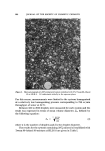
EFFECT OF SURFACTANT LOCATION ON EMULSIONS 691 Figure 7. Microphotograph of a 30% mineral oil system stabilized with 5% Tween 80-Arlacel 80 at HLB 6. All surfactants initially in the oil phase tern were dispersed in the aqueous phase prior to emulsification. It is clearly seen that, although there are some multiple emulsion droplets in the photograph, most of the oil droplets do not contain another phase. If the formation of a multiple emulsion can be regarded as the ten- dency of the system to form an inverted emulsion (W/O), the equation of Davies can be again used to explain the observed difference. Effect on Droplet Size Distribution Droplet size distributions of the freshly prepared emulsions were de- termined from enlarged microphotographs. Due to the limited resolu- tion of the optical microscope used, it was not possible to obtain accurate measurements of emulsions containing many submicron range droplets.
Purchased for the exclusive use of nofirst nolast (unknown)
From: SCC Media Library & Resource Center (library.scconline.org)