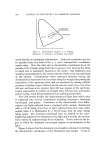
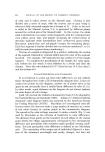
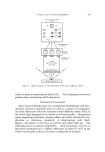
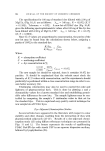
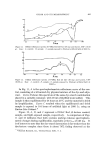
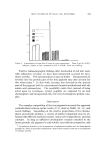
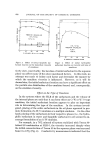
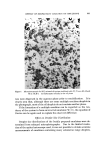
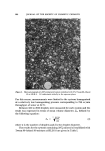
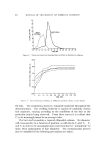
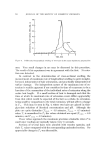
694 JOURNAL OF THE SOCIETY OF COSMETIC CHEMISTS (5 % TOTAL} 40- TWEEN 80-ARLACEL 80 HLB I0 / - • • •¸ • 20- co 0 20 40 60 80 I00 % TWEEN 80 IN AQUEOUS PHASE Figure 9. Effect of initial hydrophilic sur- factant location on emulsion stability predissolving all Tween 80 in the aqueous phase was less stable than an equivalent emulsion prepared by initially placing Tween 80 in the oil phase. However, the former emulsion produced a considerably greater amount of foam than the latter emulsion during the shaking. The presence of foam during and after emulsification could have affected the emulsions in many ways: (a) Foam could damp the shaking action to reduce the intensity of mixing operation, (b) adsorption of the surfactants at the liquid-air interface could deplete the surfactants needed at the oil-water interface to stabilize the emulsion, (c) retaining of the liquid in the foam laminas could affect true reading of the degree of separation. For this reason, shaking experiments were abandoned and a limited study was made using the turbine mixer in the emulsification vessel. The emulsions prepared in the emulsification vessel were virtually free of air bubbles and the data were fairly consistent. The example shown in Fig. 9 represents a series of emulsions stabilized with Tween 80 and Arlacel 80 at the required HLB value of the mineral oil. The emul- sion stability was determined by measuring the per cent of the volume of water separated in a graduated cylinder. In this system, placing of the surfactants in their respective phases produced a less stable emulsion than the one prepared by placing all surfactants in the oil phase. However, this observation did not apply to others as an exactly opposite effect was noted in many other systems. Since emulsion stability is an extremely complex function of droplet size distribution, rheological properties of each phase, surfactant type, concentration, etc., the limited experimental data obtained here do not

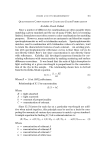
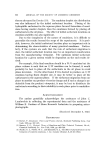
EFFECT OF SURFACTANT LOCATION ON EMULSIONS 69.5 permit generalization. However, it is evident that the initial surfactant distribution can have a significant effect on the stability of some systems. Davies discovered that HLB values of many surfactants could be cal- culated from the empirically determined structural group numbers (10, 15). He further suggested the following relationship between the coales- cence rates and HLB number: (C• Rate '•) = 2.20(HLB-7) (3) In • Rate Combining equations 1 and 3, an equation relating the HLB number to the partition coefficient of the surfactant can be obtained: (HLB-7) = 0.36 In (c•) (4) If the rate ooesurfactant migration is relatively slow, and if equation 4 is applicable, the surfactant mixture in an emulsified system can have different HLB values depending on the distribution of the constituent in the oil and water phases. Assuming that an emulsion having a maxi4 mum stability is obtained when the HLB value of the surfactant system equals that of the oil phase, it is clear that the initial surfactant location may be a significant factor affecting the emulsion stability. The HLB system developed by Griffin has been a very useful tool for emulsion chemists in spite of its limitations (16-18). The present work suggests that for the systems where the rate of surfactant migration is slow, it may be necessary to take this factor into account when determin- ing the HLB value by an empirical method. For example, a common practice of preparing an emulsion is to mix all emulsifiers into the oil phase before emulsification (19). Conceivably, for a certain system, determination of the required HLB value of the oil by such method may give a different value from that obtained by mixing all emulsifiers into the aqueous phase prior to emulsification. CONCLUSIONS Experimental studies using various nonionic surfactants indicated that the initial surfactant location could have significant effect on the physical properties of the emulsion produced. The emulsion viscosity immediately after homogenization was affected by the initial surfactant location although the effect appeared to diminish with the increase of the HLB number of the systems studied. Placing of the surfactants in the oil phase appeared to encourage the formation of a W/O emulsion or a multiple emulsion. The experimental results were consistent with the
Purchased for the exclusive use of nofirst nolast (unknown)
From: SCC Media Library & Resource Center (library.scconline.org)