J. Soc. Cosmetic Chemists, 19, 649-667 (Sept. 16, 1968) Color and Its Measurements* MICHAEL BORNSTEIN, Ph.D. t Synopsis--An account is given for the fundamental principles of diffuse and tristimulus re- flectance measurements. The experimental basis for these measurements, including the CIE and Munsell systems for defining color space, is also discussed. These principles are sup- ported with qualitative and quantitative examples for color matching, as well as interaction studies with reflectance values and the Kubelka-Munk equation. A review of several availa- ble commercial color measuring devices, reference standards, and sample preparation tech- niques are also presented. INTRODUCTION The stability and appearance of colored cosmetic and pharma- ceutical dosage forms are dependent on the dye or lake employed, as well as many other parameters. These may include adjuvant absorp- tion coefficients of microscopic and macroscopic structures as well as other physical and chemical properties (1). Although most formulators still rely on empirical knowledge in the subject of color measurement, many articles have appeared with respect to color instrumentation. Swartz and Cooper (2) have reviewed a number of pharmaceutical colorants and their properties. Lachman and associates have applied various parameters to color stability of tablet formulations (3-5). Goodhart, Lieberman, and associates (6, 7) have also studied the stabil- ity of certified dyes in tablets. Raft (8, 9) has presented reports of color measurements obtained from FD&C colorants. The purpose of this communication is to discuss principles and instru- ments used in diffuse and tristimulus reflectance measurements and their application to the development of colored pharmaceutical dosage forms. * Presented October 2, 1967, Sixth Annual A. Ph. A. Industrial Pharmaceutical Techno- logy Meeting, Chicago p Pitman-Moore Division, Dow Chemical Co., Research Center, Zionsville, Ind. 46077. Present address, Eli Lilly & Co., Indianapolis, Ind. 46206. 649

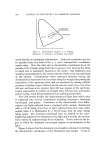
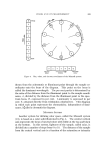
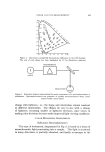
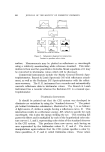
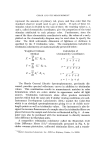
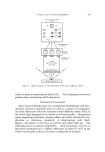
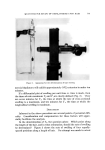
650 JOURNAL OF THE SOCIETY OF COSMETIC CHEMISTS CONCEPTS OF COLOR The sensation of color is the result of radiant energy, between 400 and 700 mu, impinging the eye (10). Since the phenomenon of color includes psychological as well as physical aspects, color scales and instruments are often designed to include both parameters. The psychological as- pects of color are the result of color codes stored in the brain, including association of an individual hue such as blue-green with a characteristic sensation such as coolness. Physical aspects of color result from the fact that visible radiant energy is necessary for vision. The basic principle on which tristimulus color measurement is based depends on the assumption that most colors may be produced by a com- bination of red, blue, and green colored lights. Red and green beams combine to form yellow, whereas blue and green combine to form a bluish-green color. A purple color results from the combination of red and blue a white hue forms when the red, green, and blue primaries unite. By varying the amounts in the three primary beams, all inter- mediate colors can be produced. This phenomenon of uniting three basic colors to form white is the basis for an additive color mixture. One may also form a subtractive color mixture by using yellow, magenta, and cyan pigments. The resultant color darkens with the subtractive mixture as more of these filters combine when all three subtractive pri- maries unite, a black color is formed. Numerous systems have been developed to define color. This discussion will be primarily concerned with the CIE and Munsell systems. CIE SYSTEM There are two basic foundations on which colorimetry depends. The first is that color can be matched by a suitable mixture of three selected light radiations and that if two colors are matched by three radiations, the mixture of these two colors is found additive by suitable optical means. The essential principles of this tristimulus color system were first independently developed by Ives (ll) and Guild (12). In 1931, the Commission Internationale de l'Eclairge (CIE) standardized the color mixture characteristics of an "average observer" and developed a stand- ard framework for a color specification. This standard observer represents a series of functions determined from data provided by observers matching the color at each wavelength from 400 to 700 m•, with mixtures from three primary light sources. The experimental set-up for defining the "average" human observer measures the observer's response to the three primary colors by focusing
Purchased for the exclusive use of nofirst nolast (unknown)
From: SCC Media Library & Resource Center (library.scconline.org)