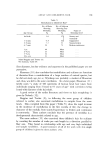
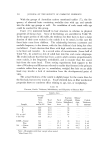
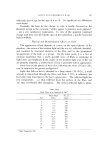
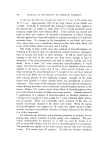
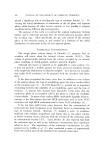
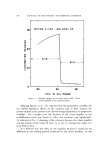
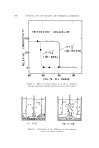
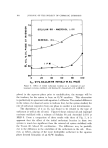
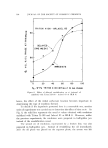
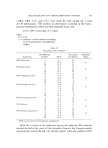
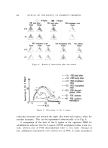
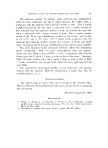
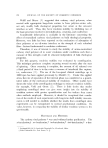
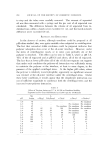
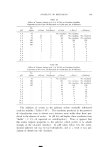
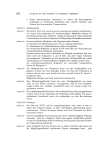
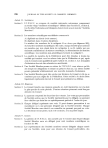
194 JOURNAL OF THE SOCIETY OF COSMETIC CHEMISTS I I I I • SOLULAN 98 - AMERCHOL L-IOI 7z • 68 • 66 0 20 40 60 80 I00 Xh, WT.% SOLULAN 98 INITIALLY IN All. PHASE Figure 6. Effect of initial surfactant location on qo (mineral oil and isopropyl myristate stabilized with Solulan 98 - Amerchol L-101 at HLB 8) placed in the aqueous phase prior to emulsification, the stronger will be the tendency for the system to form an O/W emulsion. This observation is qualitatively in agreement with equation 1 of Davies. The marked difference in the values of 4 observed seems to indicate that, for the system studied, the rate of surfactant migration from one phase to another is not instantaneous. The dependency of 4• on 2f• was found to be related to the type of surfactant as well as the oil used. Figure 6 shows mineral oil and isopropyl myristate stabilized with a mixture of Solulan 98 and Amerchol L-101 at HLB 8. From a comparison of these results with those of Fig. 5, it is apparent that the effect of the initial surfactant location in these two systems is much less significant than the mineral oil system stabilized with the Tween 80--Arlaccl 80 combination. The difference may be partially due to the difference in the solubilities of the surfactants in the oils. How- ever, as before, placing of the more hydrophilic surfactant in the aqueous phase favored formation of an O/W emulsion.

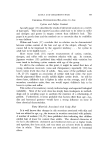
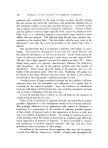
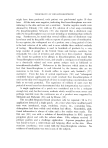
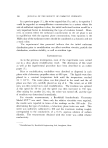
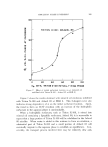
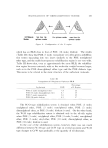
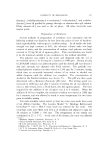
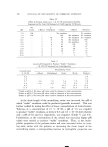
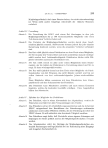
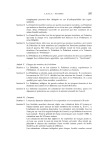
EMULSION PHASE INVERSION 195 Z t•' IOO I I I I TRITON X-IO0- ARLACEL 83 i I I I 0 20 40 60 80 I00 Xh, WT.% TRITONX-IO0 INITIALLY INAQ. PHASE Figure 7. Effect of initial surfactant location on q, (mineral oil stabilized with Triton X-100 - Arlacel g3 at HLB g) Figure 7 shows the results obtained with mineral oil emulsions stabilized with Triton X-100 and Arlacel 83 at HLB 8. This S-shaped curve also indicates strong dependency of ½ on the initial surfactant location. Again, the trend to form an O/W emulsion with an increase of the hydrophilic surfactant in the aqueous phase is unmistakable. When a hydrophilic surfactant, such as Triton X-100, is mixed into mineral oil containing a lipophilic surfactant, Arlacel 80, it is reasonable to expect that a large portion of Triton X-100 will be solubilized in the Arlacel 80 micelies. When water is added to this mixture to form an emulsion, a substantial part of Triton X-100 and a small portion of Arlacel 83 will eventually migrate to the aqueous phase to establish an equilibrium. Con- ccivably, the transport process involved here may be relatively slow and,
Purchased for the exclusive use of nofirst nolast (unknown)
From: SCC Media Library & Resource Center (library.scconline.org)