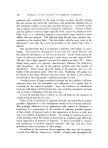
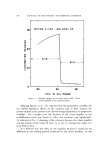
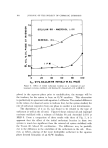
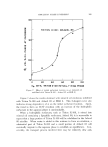
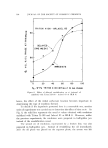
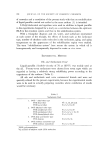
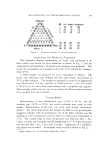
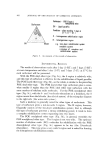
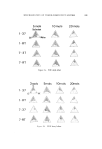
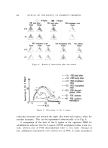
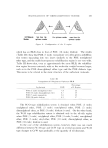
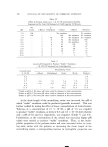
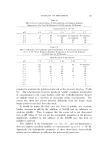
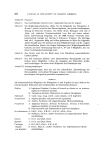
196 JOURNAL OF THE SOCIETY OF COSMETIC CHEMISTS [ ' ' ' ' 4 z TRITON x-moo- ARLACEL 83 80 IMMEDIATE '70 0 20 40 60 80 I00 Xh, Vl/I% TRITON X-IOOINITIALLY IN AQ. PHASE Figure 8. Effect of delayed emulsification on • (mineral oil stabilized with Triton X-100 - Arlacel 83 at HLB 8) hence, the effect of the initial surfactant location becomes important in determining the type of emulsion formed. To decide if the hypothesis presented here is a reasonable one, another series of experiments was carried out to determine the effect of time on 4. In Fig. 8, the solid line represents the usual • values obtained with emulsions stabilized with Triton X-100 and Arlacel 83 at HLB 8. However, unlike the previous experiments, the emulsions were prepared in half-gallon jars instead of the emulsification vessel. The second set of emulsions, represented by a broken line, was also prepared in half-gallon jars. Instead of emulsifying the oil immediately after the oil phase was placed on the aqueous phase, the system was left

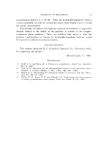
EMULSION PHASE INVERSION 197 undisturbed for one week prior to emulsification. During the one week, the surfactants in one phase were free to migrate to the other phase by diffusion through the interface. As expected, the delayed emulsification reduced the difference in the surfactant distribution and, as the result, the curve became more flat. However, it was somewhat surprising that even after one week of standing, the 4-curve was not nearly flat, indicating that the surfactant concentration had not reached equilibrium. Apparently, for the system studied, the rate of surfactant migration was not very rapid under the static condition. It is nevertheless clear that the distribution of the surfactants in the oil and aqueous phases prior to emulsification plays a very important role in determining the type of emulsion formed. CONCLUSIONS The experimental data presented demonstrate the importance of the initial surfactant location in controlling the emulsion phase inversions. In the systems studied, placing of more surfactant in the aqueous phase favored formation of an O/W emulsion and produced an increase in the volume of oil phase at inversion, 4. This may be interpreted as due to an increase in the "dynamic" HLB value of the system as can be expected from equation 3 of Davies. In addition to the initial surfactant location, the type of oil, the type of surfactant, as well as the mixer location, also affected the type of emulsion formed. The effect of the mixer location was believed to be due to the variation in the flow pattern created. (Received August 5, 1968) REFERENCES (1) Lin, T. J., Effect of initial surfactant location on the viscosity of emulsions, J. Soc. Cosmetic Chemists., 19, 683-97 (1968). (2) Ostwald, W., Beitrage zur Kenntmis der Emulsionen, Kolliod-Z., 6, 103-9 (1910). (3 Bhatnager, S.S., Studies in emulsions, Part 1, J. Chem. Soc. (London) 117, 542-52 (1920). (4 Becher, P., Emulsions: Theory and Practice, 2nd ed., Reinhold Publishing Corp., New York, 1965, p. 96. (5 Bancroft, W. D., The theory of emulsification, J. Phys. Chem. 17, 501-19 (1913). (6 Griffin, W. C., Classification of surface-active agents by "HLB," J. Soc. Cosmetic Chemists, 1, 311-26 (1949).
Purchased for the exclusive use of nofirst nolast (unknown)
From: SCC Media Library & Resource Center (library.scconline.org)